
Project Leader: Dörthe Handorf, Johannes Quaas, Vera Schemann




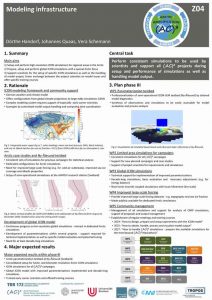
During phase II of (AC)³ the focus of applied models has been shifted to the ICON family, in order to allow consistent simulation chains and benefit from a simpler evaluation and improvement of parameterizations. To reach the goals of the third phase of (AC)³ it is necessary to increase the use of models and strengthen the application of observational datasets in or together with models. This will lead to an increased demand for dedicated simulations and support for the assessment of model output. The increase in computational power during recent years and decades as well as coordinated model comparison projects, led to an enormous amount of data and huge requirements in data science and the treatment of big data. In order to provide the required simulations and model output to the scientific projects within (AC)³ as well as to support and train especially the early career scientists during the work with model codes, the setup of simulations and the handling of the model output, we propose a new project on modeling infrastructure. The main aims will be to
- Setup and perform high-resolution simulations with ICON for regional areas in the Arctic to be used and analyzed in (AC)³-projects; Prepare, setup and perform global simulations with a special Arctic focus to be used and analyzed in (AC)³-projects;
- Support (AC)³-scientists for the setup of specific simulations as well as the handling of model output, foster exchange between the project scientists on model related issues and offer specific training courses
Link to Arctic amplification: Models are a key tool to assess the three overarching themes of phase III of (AC)³. They are essential to define and explain feedback mechanisms, linkages and especially to predict future changes. High-resolution simulations support research to improve process understanding, that is key to better understand the different components of the Arctic system and their contribution to Arctic amplification (SQ1). Long-term global simulations will enable better conclusions on the quantification of the effects of Arctic midlatitude connections on Arctic amplification (SQ2) and on the evolution of Arctic amplification in the future (SQ3). As the preparation and application of model simulations as well as the educated interpretation of simulation results and predictions got increasingly complex, it is also key to support especially early career scientists during the setup of simulations and the analysis of the output.
Project Posters
| Phase III Evaluation poster 2023 | ||
 |
Project Members
Project Leader in A03 , D01 , Z04
Alfred Wegener Institute
Telegrafenberg A45
14473 Potsdam
++49 (0) 331 58174 5204
mail:
[email protected]
Postdoc in Z04
Institute for Geophysics and Meteorology (IGM)
University of Cologne
Pohligstr. 3
50969 Cologne
mail:
[email protected]
Project Leader in D01 , E01 , E06 , Z04
Leipzig Institute for Meteorology (LIM)
University of Leipzig
Stephanstr. 3
04103 Leipzig
++49 (0) 341 97 32852
mail:
[email protected]
Project Leader in E03 , Z04
Institute for Geophysics and Meteorology (IGM)
University of Cologne
Pohligstr. 3
50969 Cologne
++49 (0) 221 470 6489
mail:
[email protected]

Postdoc in Z04
Institute for Geophysics and Meteorology (IGM)
University of Cologne
Pohligstr. 3
50969 Cologne
mail:
[email protected]


 .
.