
Project Leaders: Hartmut Bösch, Marco Vountas (former PL: John P. Burrows)


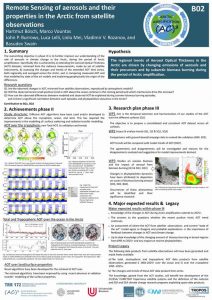
The quantification of the impacts of aerosols in the Arctic requires an understanding of the seasonally dependent long-range transport of pollution from lower latitudes, ice and snow melt, local aerosol sources, dry and wet deposition of aerosol particles, and aerosol-cloud interactions. However, the sign and magnitude of Arctic aerosol radiative forcing during the period of Arctic amplification is not adequately understood. For instance, global models have difficulties in simulating low-altitude Arctic mixed-phase clouds (Pithan et al., 2016). Part of this difficulty is because the subsets of the aerosol population, which act as Cloud Condensation Nuclei (CCN) and Ice Nucleating Particles (INP), are not sufficiently well represented. The number of ground-based measurements of AOT in the Arctic is small and the coverage is intrinsically sparse. Thus, improved knowledge of Arctic aerosols and their radiative effects is required to understand their changes and their impact on the Arctic climate during the period of Arctic amplification. During the polar day, the retrieval of AOT from the measurements of passive remote sensing instrumentation on polar-orbiting satellites provides potentially a high spatial resolution aerosol data product having broad coverage and high temporal sampling. The scientific objectives of this project address the need to quantify the change in Aerosol Optical Thickness (AOT) (Mei et al., 2020c, Mei et al., 2020b; Vountas et al., 2020), the aerosol types, and their composition during the period of Arctic amplification.
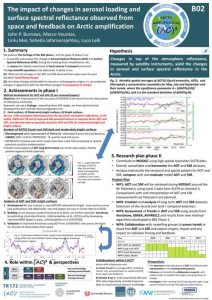
In phase II of (AC)³, the importance of volcanic eruptions, which reach the stratosphere, on the stratospheric and total AOT, and their impact on the AOT trends were identified. To resolve this issue for the period from 1981 to 2020 (i) the NOAA AVHRR total AOT dataset (merged with our own AOT retrievals over water using the XBAER, eXtensible Bremen AErosol Retrieval algorithm applied to MERIS and OLCI data, for more details see below) was optimized by filtering clouds and ice/snow over the ocean. We have observed small but statistically significant positive trends for this dataset; (ii) a new stratospheric AOT dataset was generated by merging aerosol extinction, retrieved from passive remote sensing limb measurements and the active remote sensing measurements of CALIOP above the ocean in the Arctic; (iii) a tropospheric AOT dataset was generated by subtracting the stratospheric AOT from the total AOT above the ocean in the Arctic. These spatially resolved and temporally sampled datasets were analyzed and their changes and trends were investigated. In addition, a total AOT dataset was created over snow and ice-covered Arctic surfaces from 2003 to 2012. The dataset was retrieved using the AEROSNOW retrieval algorithm developed at IUP. Significant differences between the AOT simulated by a chemical transport model (GEOS-Chem, e.g., (Bey et al., 2001)) and the AEROSNOW AOT retrievals were observed during episodes of biomass burning. Active satellite remote sensing of aerosol by CALIOP was used to validate the passive satellite remote sensing AOT data products, used and retrieved in this study.
Hypothesis:
The regional trends of Aerosol Optical Thickness (AOT) in the Arctic are driven by changing emissions of aerosols and their precursors and by subarctic biomass burning during the period of Arctic amplification.
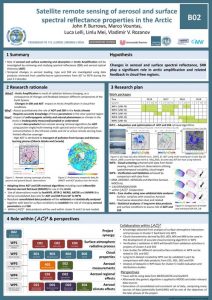
In phase III we will answer the following questions related to the hypothesis:
- How well are the observed changes in AOT, retrieved from satellite observations, reproduced by atmospheric models, and what are the reasons for the differences?
- Will the recently observed small positive trend in AOT above the ocean in the Arctic continue in the period 2020 to 2025 and which mechanisms drive this increase?
- How can the observed differences between modeled and observed AOT be explained during summer biomass burn episodes, and is there a significant correlation between such episodes and phytoplankton dynamics in the Arctic?
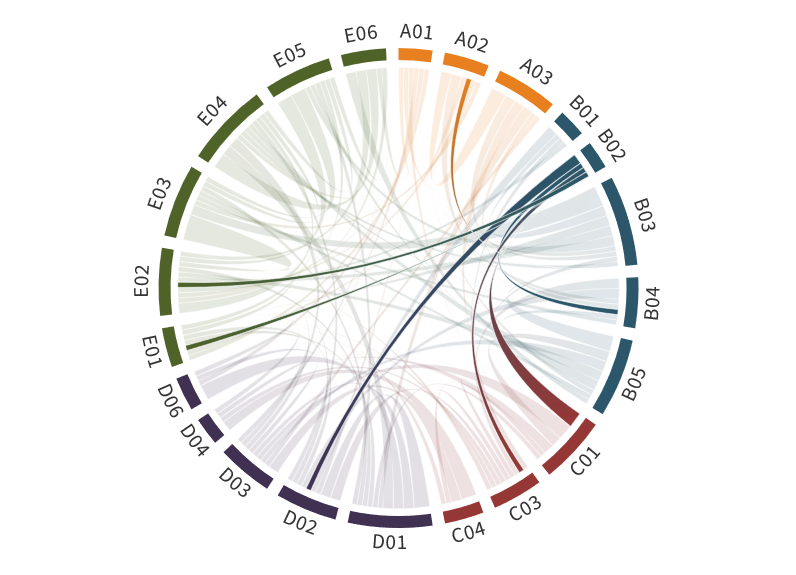
Project B02 addresses key goals of (AC)³ by investigating the changes in AOT and corresponding radiation fluxes using satellite observations over the Arctic. It is one of the (AC)³ projects, which investigates the behavior of AOT from the local to the pan-Arctic scale. The B02 research addresses two of the (AC)³ Strategic Questions (SQs). It contributes to SQ1, which focuses on the causes of Arctic amplification, by determining the changes in total, stratospheric, and tropospheric AOT and assessing their impact on Arctic amplification and vice versa; SQ3, which investigates the evolution of AOT during the Arctic amplification, by comparing the AOT in the Arctic, retrieved from observations and climate models, which enabled the accuracy of AOT simulations and projections of climate models to be assessed.
Achievements phase I
B02 exploits satellite data for detection of changes in Arctic aerosol. This is quite challenging and different approaches are needed from different surface types those spectral surface reflectance (SSR) is also of interest. Over the Arctic open waters a first long-term record of Aerosol Optical Thickness (AOT) covering a period of more than 35 years shows a significant increase of AOT over the Fram Strait during haze season, and over the Chuchki Sea during September. The record also indicate a significant increase of AOT over the northeast passage during July and September. Improved retrievals for dark to moderately bright surfaces, such as snow/ice-free land and ocean (Jafariserajehlou et al., 2019) were developed. Progress has also been made in the field of AOT/SSR retrievals over bright surfaces (snow/ice covered areas) with a novel retrieval, which benefits from improved knowledge of aerosol typing and SSR treatment.
Role within (AC)³
Project Posters
| Phase III Evaluation poster 2023 | Phase II Evaluation poster 2019 | Phase I Evaluation poster 2015 |
 |
 |
 |
Project Members
PhD in B02
Institute of Environmental Physics (IUP)
University of Bremen
Otto-Hahn-Allee 1
28359 Bremen
mail:
[email protected]
Project Leader in B02 , E06
Institute of Environmental Physics (IUP)
University of Bremen
Otto-Hahn-Allee 1
28359 Bremen
++49 (0) 421 218 62777
mail:
[email protected]

PhD in B02
Institute of Environmental Physics (IUP)
University of Bremen
Otto-Hahn-Allee 1
28359 Bremen
mail:
[email protected]

Publications
2026
Vinjamuri, K. S., Vountas, M., Rozanov, V., Lelli, L., Boesch, H., and Burrows, J. P. , 2026: Cloud phase classification using SLSTR measured brightness temperatures at 3.74, 10.85, 12.00 µm. J Quant Spectrosc Radiat Transf., 357:109897, doi:10.1016/j.jqsrt.2026.109897
Mchedlishvili, A., Vountas, M., and Bösch, H. , 2026: The anomalously warm summer of 2023 over Greenland as compared to previous record melt summers of 2012 and 2019. Cryosphere, 20(5):2895–2922, doi:10.5194/tc-20-2895-2026
Swain, B., Vountas, M., Singh, A., Panda, U., Song, R., Anchan, N. L., Malasani, C. R., Mallick, D., Alawode, R., Deroubaix, A., Lelli, L., Schmale, J., Tandon, A., Gunthe, S. S., Wendisch, M., Hari, V., and Bösch, H. , 2026: Contrasting anthropogenic drivers behind asymmetric warming in the arctic and antarctica. Ocean-Land-Atmos. Res., 5:0127, doi:10.34133/olar.0127
2025
Swain, B., Vountas, M., Singh, A., Anchan, N. L., Malasani, C. R., Mallick, D., Deroubaix, A., Lelli, L., Patel, N., Alawode, R., Gunthe, S. S., Grainger, R. G., Schmale, J., Hari, V., Kokhanovsky, A., Wendisch, M., Bösch, H., and Burrows, J. P. , March 2025: Insights of Aerosol-Precipitation Nexus in the Central Arctic through CMIP6 Climate Models. Npj Clim Atmos. Sci, 8(1):103, doi:10.1038/s41612-025-00957-6
2024
Anchan, N. L., Swain, B., Sharma, A., Singh, A., Malasani, C. R., Chandrasekharan, A., Kumar, U., Ojha, N., Liu, P., Vountas, M., and Gunthe, S. S. , September 2024: Assessing the Variability of Aerosol Optical Depth Over India in Response to Future Scenarios: Implications for Carbonaceous Aerosols. J. Geophys. Res. Atmospheres, 129(18):e2024JD040846, doi:10.1029/2024JD040846
Swain, B., Vountas, M., Singh, A., Anchan, N. L., Deroubaix, A., Lelli, L., Ziegler, Y., Gunthe, S. S., Bösch, H., and Burrows, J. P. , May 2024: Aerosols in the Central Arctic Cryosphere: Satellite and Model Integrated Insights during Arctic Spring and Summer. Atmos. Chem Phys, 24(9):5671–5693, doi:10.5194/acp-24-5671-2024
Swain, B., Vountas, M., Deroubaix, A., Lelli, L., Ziegler, Y., Jafariserajehlou, S., Gunthe, S. S., Herber, A., Ritter, C., Bösch, H., and Burrows, J. P. , January 2024: Retrieval of Aerosol Optical Depth over the Arctic Cryosphere during Spring and Summer Using Satellite Observations. Atmos. Meas Tech, 17(1):359–375, doi:10.5194/amt-17-359-2024
Malasani, C. R., Swain, B., Patel, A., Pulipatti, Y., Anchan, N. L., Sharma, A., Vountas, M., Liu, P., and Gunthe, S. S. , 2024: Modeling of Mercury Deposition in India: Evaluating Emission Inventories and Anthropogenic Impacts. Environ. Sci. Process. Impacts, 26(11):1999–2009, doi:10.1039/D4EM00324A
2023
Shi, Z., Xie, Y., Li, Z., Zhang, Y., Chen, C., Mei, L., Xu, H., Wang, H., Zheng, Y., Liu, Z., Hong, J., Zhu, M., Qie, L., Zhang, L., Fan, C., and Guang, J. , September 2023: A Generalized Land Surface Reflectance Reconstruction Method for Aerosol Retrieval: Application to the Particulate Observing Scanning Polarimeter (POSP) Onboard GaoFen-5 (02) Satellite. Remote Sens. Environ., 295:113683, doi:10.1016/j.rse.2023.113683
Mei, L., Rozanov, V., Rozanov, A., and Burrows, J. P. , March 2023: SCIATRAN Software Package (V4.6): Update and Further Development of Aerosol, Clouds, Surface Reflectance Databases and Models. Geosci. Model Dev., 16(5):1511–1536, doi:10.5194/gmd-16-1511-2023
Lelli, L., Vountas, M., Khosravi, N., and Burrows, J. P. , February 2023: Satellite Remote Sensing of Regional and Seasonal Arctic Cooling Showing a Multi-Decadal Trend towards Brighter and More Liquid Clouds. Atmos. Chem Phys, 23(4):2579–2611, doi:10.5194/acp-23-2579-2023
2022
Mei, L., Rozanov, V., Jiao, Z., and Burrows, J. P. , June 2022: A New Snow Bidirectional Reflectance Distribution Function Model in Spectral Regions from UV to SWIR: Model Development and Application to Ground-Based, Aircraft and Satellite Observations. ISPRS J. Photogramm. Remote Sens., 188:269–285, doi:10.1016/j.isprsjprs.2022.04.010
2021
Mei, L., Rozanov, V., Pohl, C., Vountas, M., and Burrows, J. P. , June 2021: The Retrieval of Snow Properties from SLSTR Sentinel-3 – Part 1: Method Description and Sensitivity Study. The Cryosphere, 15(6):2757–2780, doi:10.5194/tc-15-2757-2021
Mei, L., Rozanov, V., Jäkel, E., Cheng, X., Vountas, M., and Burrows, J. P. , June 2021: The Retrieval of Snow Properties from SLSTR Sentinel-3 – Part 2: Results and Validation. The Cryosphere, 15(6):2781–2802, doi:10.5194/tc-15-2781-2021
Jafariserajehlou, S., Rozanov, V. V., Vountas, M., Gatebe, C. K., and Burrows, J. P. , January 2021: Simulated Reflectance above Snow Constrained by Airborne Measurements of Solar Radiation: Implications for the Snow Grain Morphology in the Arctic. Atmos. Meas Tech, 14(1):369–389, doi:10.5194/amt-14-369-2021
2020
Vountas, M., Belinska, K., Rozanov, V. V., Lelli, L., Mei, L., Jafariserajehlou, S., and Burrows, J. P. , November 2020: Retrieval of Aerosol Optical Thickness and Surface Parameters Based on Multi-Spectral and Multi-Viewing Space-Borne Measurements. J. Quant. Spectrosc. Radiat. Transf., 256:107311, doi:10.1016/j.jqsrt.2020.107311
Mei, L., Rozanov, V., and Burrows, J. P. , November 2020: A Fast and Accurate Radiative Transfer Model for Aerosol Remote Sensing. J. Quant. Spectrosc. Radiat. Transf., 256:107270, doi:10.1016/j.jqsrt.2020.107270
Mei, L., Vandenbussche, S., Rozanov, V., Proestakis, E., Amiridis, V., Callewaert, S., Vountas, M., and Burrows, J. P. , May 2020: On the Retrieval of Aerosol Optical Depth over Cryosphere Using Passive Remote Sensing. Remote Sens. Environ., 241:111731, doi:10.1016/j.rse.2020.111731
2019
Mei, L., Rozanov, V., Jethva, H., Meyer, K. G., Lelli, L., Vountas, M., and Burrows, J. P. , October 2019: Extending XBAER Algorithm to Aerosol and Cloud Condition. IEEE Trans. Geosci. Remote Sens., 57(10):8262–8275, doi:10.1109/TGRS.2019.2919910
Mei, L., Strandgren, J., Rozanov, V., Vountas, M., Burrows, J. P., and Wang, Y. , September 2019: A Study of the Impact of Spatial Resolution on the Estimation of Particle Matter Concentration from the Aerosol Optical Depth Retrieved from Satellite Observations. Int. J. Remote Sens., 40(18):7084–7112, doi:10.1080/01431161.2019.1601279
Ding, A., Jiao, Z., Dong, Y., Zhang, X., Peltoniemi, J. I., Mei, L., Guo, J., Yin, S., Cui, L., Chang, Y., and Xie, R. , July 2019: Evaluation of the Snow Albedo Retrieved from the Snow Kernel Improved the Ross-Roujean BRDF Model. Remote Sens., 11(13):1611, doi:10.3390/rs11131611
Wendisch, M., Macke, A., Ehrlich, A., Lüpkes, C., Mech, M., Chechin, D., Dethloff, K., Velasco, C. B., Bozem, H., Brückner, M., Clemen, H., Crewell, S., Donth, T., Dupuy, R., Ebell, K., Egerer, U., Engelmann, R., Engler, C., Eppers, O., Gehrmann, M., Gong, X., Gottschalk, M., Gourbeyre, C., Griesche, H., Hartmann, J., Hartmann, M., Heinold, B., Herber, A., Herrmann, H., Heygster, G., Hoor, P., Jafariserajehlou, S., Jäkel, E., Järvinen, E., Jourdan, O., Kästner, U., Kecorius, S., Knudsen, E. M., Köllner, F., Kretzschmar, J., Lelli, L., Leroy, D., Maturilli, M., Mei, L., Mertes, S., Mioche, G., Neuber, R., Nicolaus, M., Nomokonova, T., Notholt, J., Palm, M., Van Pinxteren, M., Quaas, J., Richter, P., Ruiz-Donoso, E., Schäfer, M., Schmieder, K., Schnaiter, M., Schneider, J., Schwarzenböck, A., Seifert, P., Shupe, M. D., Siebert, H., Spreen, G., Stapf, J., Stratmann, F., Vogl, T., Welti, A., Wex, H., Wiedensohler, A., Zanatta, M., and Zeppenfeld, S. , May 2019: The Arctic Cloud Puzzle: Using ACLOUD/PASCAL Multiplatform Observations to Unravel the Role of Clouds and Aerosol Particles in Arctic Amplification. Bull. Am. Meteorol. Soc., 100(5):841–871, doi:10.1175/BAMS-D-18-0072.1
Jiao, Z., Ding, A., Kokhanovsky, A., Schaaf, C., Bréon, F., Dong, Y., Wang, Z., Liu, Y., Zhang, X., Yin, S., Cui, L., Mei, L., and Chang, Y. , February 2019: Development of a Snow Kernel to Better Model the Anisotropic Reflectance of Pure Snow in a Kernel-Driven BRDF Model Framework. Remote Sens. Environ., 221:198–209, doi:10.1016/j.rse.2018.11.001
Jafariserajehlou, S., Mei, L., Vountas, M., Rozanov, V., Burrows, J. P., and Hollmann, R. , February 2019: A Cloud Identification Algorithm over the Arctic for Use with AATSR–SLSTR Measurements. Atmos. Meas Tech, 12(2):1059–1076, doi:10.5194/amt-12-1059-2019
2018
Che, Y., Mei, L., Xue, Y., Guang, J., She, L., Li, Y., Heckel, A., and North, P. , September 2018: Validation of Aerosol Products from AATSR and MERIS/AATSR Synergy Algorithms—Part 1: Global Evaluation. Remote Sens., 10(9):1414, doi:10.3390/rs10091414
Mei, L., Rozanov, V., Vountas, M., Burrows, J. P., and Richter, A. , February 2018: XBAER-derived Aerosol Optical Thickness from OLCI/Sentinel-3 Observation. Atmos. Chem Phys, 18(4):2511–2523, doi:10.5194/acp-18-2511-2018
Lelli, L. and Vountas, M. Aerosol and Cloud Bottom Altitude Covariations From Multisensor Spaceborne Measurements. In Remote Sensing of Aerosols, Clouds, and Precipitation, pages 109–127. Elsevier, 2018. doi:10.1016/B978-0-12-810437-8.00005-0.
2017
Lelli, L., Rozanov, V. V., Vountas, M., and Burrows, J. P. , October 2017: Polarized Radiative Transfer through Terrestrial Atmosphere Accounting for Rotational Raman Scattering. J. Quant. Spectrosc. Radiat. Transf., 200:70–89, doi:10.1016/j.jqsrt.2017.05.027
Mei, L., Rozanov, V., Vountas, M., Burrows, J. P., Levy, R. C., and Lotz, W. , August 2017: Retrieval of Aerosol Optical Properties Using MERIS Observations: Algorithm and Some First Results. Remote Sens. Environ., 197:125–140, doi:10.1016/j.rse.2016.11.015
She, L., Mei, L., Xue, Y., Che, Y., and Guang, J. , March 2017: SAHARA: A Simplified AtmospHeric Correction AlgoRithm for Chinese gAofen Data: 1. Aerosol Algorithm. Remote Sens., 9(3):253, doi:10.3390/rs9030253
Wendisch, M., Brückner, M., Burrows, J., Crewell, S., Dethloff, K., Ebell, K., Lüpkes, C., Macke, A., Notholt, J., Quaas, J., Rinke, A., and Tegen, I. , January 2017: Understanding Causes and Effects of Rapid Warming in the Arctic. Eos, doi:10.1029/2017EO064803


 .
.