
Project Leaders: Heike Kalesse-Los, Maximilian Maahn



In this new project, we are focusing on the processes of sublimation and evaporation. Precipitation is an essential component of the Arctic climate system as part of the hydrological cycle, linking the atmosphere and cryosphere through snowfall. Much of the Arctic precipitation sublimates before it reaches the ground due to dry sub-cloud layers. For example, near-surface snowfall amounts are reduced by more than 20 % compared to observations at 600 m altitude in Ny-Ålesund (NYA). This is related to winds caused by a land-sea circulation, but sublimation is not limited to regions with persistent local wind systems; sublimation losses of 40-60% have been observed for the Mackenzie Basin in northern Canada. Despite the importance of this process, atmospheric models have difficulties in simulating sublimation rates correctly because this process depends on complex, hydrometeor dependent properties and can feed back on cloud properties. These feedbacks will be potentially altered by a shift from sublimation to evaporation in a warming Arctic with more rainfall. In this new project, we will focus on improving the understanding of sublimation and– from the remote sensing perspective–evaporation as well as the associated feedback processes in the Arctic atmosphere. To characterize these processes, we propose to combine observational and atmospheric modeling approaches. Specifically, the synergistic long-term remote sensing data sets of cloud radars, (Doppler) lidar and microwave radiometers from Arctic observations (NYA, Utqiaġvik/North Slope of Alaska NSA, MOSAiC, (AC)³ airborne campaigns) and the new G-band Radar for Water vapor and Arctic Clouds (GRaWAC, see E03) will be used in combination with ground-based precipitation measurements, including a novel Video In Situ Snowfall Sensor (VISSS), to quantify how much precipitation sublimates or evaporates in the sub-cloud layer. The observations will be used to evaluate and improve the sublimation parameterizations in ICON-LEM. Furthermore, ICON-LEM will be used to study the feedback effects of atmospheric sublimation on atmospheric boundary layer (ABL) structure and clouds.
Hypothesis:
Atmospheric sublimation and evaporation are not only influenced by large-scale atmospheric drivers but also by small-scale (sub)cloud properties and impact cloud properties through feedback mechanisms.
Specifically we want to answer the following questions:
- How much precipitation sublimates or evaporates sub-cloud at different Arctic sites?
- Which large- and small-scale drivers influence atmospheric sublimation and evaporation?
- Can we improve the sublimation process and its feedback mechanisms in ICON-LEM?
We aim to better understand sublimation and evaporation, which are embedded in the feedback loops of Arctic amplification. We thus contribute to the overarching theme of SQ1.
Role within (AC)³
Project Posters
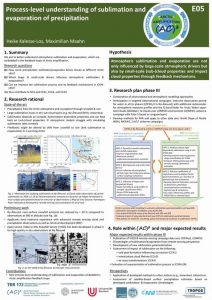
| Phase III Evaluation poster 2023 | ||
 |
Project Members

PhD in E05
Leipzig Institute for Meteorology (LIM)
University of Leipzig
Stephanstr. 3
04103 Leipzig
++49 (0) 341 97 32880
mail:
[email protected]

Postdoc in E05
Leipzig Institute for Meteorology (LIM)
University of Leipzig
Stephanstr. 3
04103 Leipzig
++49 (0) 341 97 36661
mail:
[email protected]


Publications
2026
Di Natale, G., Brindley, H., Warwick, L., Panditharatne, S., Yang, P., David, R. O., Carlsen, T., Vâjâiac, S. N., Vlad, A., Ghemuleț, S., Bantges, R., Foth, A., Flügge, M., Lyngra, R., Oetjen, H., Schuettemeyer, D., Palchetti, L., and Murray, J. , 2026: Achieving consistency between in-situ and remotely sensed optical and microphysical properties of Arctic cirrus: The impact of far-infrared radiances. Atmos. Chem. Phys., 26(2):1373–1394, doi:10.5194/acp-26-1373-2026
2025
Scarsi, F. E., Battaglia, A., Maahn, M., and Lhermitte, S. , 2025: How to reduce sampling errors in spaceborne cloud radar-based snowfall estimates. Cryosphere, 19(10):4875–4892, doi:10.5194/tc-19-4875-2025
2024
Maherndl, N., Moser, M., Schirmacher, I., Bansemer, A., Lucke, J., Voigt, C., and Maahn, M. , December 2024: How does riming influence the observed spatial variability of ice water in mixed-phase clouds? Atmos. Chem Phys, 24(24):13935–13960, doi:10.5194/acp-24-13935-2024


 .
.