
Project Leaders: Vera Schemann, Sabrina Schnitt (former PLs: Stefan Kneifel, Roel Neggers, Yaping Shao, Ulrich Löhnert)


The occurrence, persistence, and dissolution of Arctic mixed-phase clouds (MPC) are important factors to describe relevant processes for Arctic amplification and to understand the evolution of the Arctic system under global warming. During phase II, the observational capabilities at the Arctic research station AWIPEV in Ny-Ålesund (NYA) were extended by installing a new polarimetric Ka-band radar. The dual-frequency Ka-W-band radar measurements revealed new insights into ice microphysical and precipitation formation processes. Alongside, a unique semi-operational ICON simulation testbed was established for NYA. So far, approximately 2.5 years of cloud- resolving simulations have been performed by starting a simulation with 600m resolution every day based on operational weather forecast forcing. The corresponding statistical analysis showed a good agreement with observations, but revealed also model uncertainties and open questions. In phase III, we will combine simulations with measurements from ground-based, and previous as well as upcoming campaigns to investigate how MPC properties are influenced by large-scale forcing and surroundings as well as by the micro-scale. One focus will be on the differences caused by surface properties – like open ocean and sea-ice – and the island effect around Svalbard. We suspect the model performance to depend on the synoptic situation, which can be characterized by circulation weather types. Another open question is the sensitivity of MPC on local circumstances and especially on known uncertainties in number of Cloud Condensation Nuclei (CCN) and Ice Nucleating Particles (INP). To understand these dependencies, we will benchmark the model by CCN and INP measurements from phase I and II. The analysis on the micro-scale will be complemented by investigating the uncertainties connected to the moisture availability and in-cloud water phase distribution for formation and persistence of MPC. In order to evaluate the model, triple-frequency radar observations in combination with the Differential Absorption Radar technique are envisioned to gain a unique characterization of MPC and corresponding hydrometeor distributions.
Hypothesis:
The representation of Arctic mixed-phase clouds at Ny-Ålesund is on the smallscale strongly dependent on local effects, but on the large-scale representative for a larger area.
Central research question which directly follow from our hypothesis are:
- How comparable are modeled and observed MPC properties at NYA to the surroundings including other surface types?
- How strongly does the model performance depend on the circulation weather type? And why?
- How important are the modeled representation of CCN/INP, water phase transitions and moisture supply for the persistence and dissolution of low-level MPC?
Arctic MPC and their contribution to atmospheric feedback processes are one important phenomenon responsible for Arctic amplification. Nevertheless, the strength of this contribution, its representation in current climate projections, and the sensitivity on necessary simplifications and assumptions is still under debate, which requires further observational evidence for model evaluation. The process understanding created within this project will support the interpretation of the contribution of Arctic MPC to Arctic amplification (SQ1). Especially the evolution of Arctic MPC in continued warming trends and the related changes in water phase transition and precipitation formation will strongly influence the future of the Arctic climate system (SQ3).
Achievements phase II
- Continuous multi-frequency and polarimetric radar measurements at NYA to advance understanding and modeling of precipitation-forming microphysical processes
- Semi-operational ICON-LEM simulations (600 m) every day, covering more than 2.5 years
- Statistical assessment of simulations and observations showed lack of liquid water in simulated clouds and a need for detailed analysis of water phase transitions
Achievements phase I
E03 has characterised persisting low-level, mixed-phase clouds in an Arctic environment, including complex orography and high synoptic variability (Ny-Ålesund) by means of a novel, combined radar/radiometer system (Küchler et al., 2017). Idealised, ultra-highly resolved (up to 3 m) LES of mixed-phase clouds over sea ice and respective sensitivity studies concerning model resolution and surface patterns were performed. An innovative, nested ICON-LEM modelling framework for the simulation of Arctic mixed-phase clouds over a complex terrain on the 100 m-scale combined with a consistent radar forward operator was developed. It was shown that large-scale subsidence acts as a remote control on ABL deepening with the potential to cloud base collapse and driving into a cloud-free state.
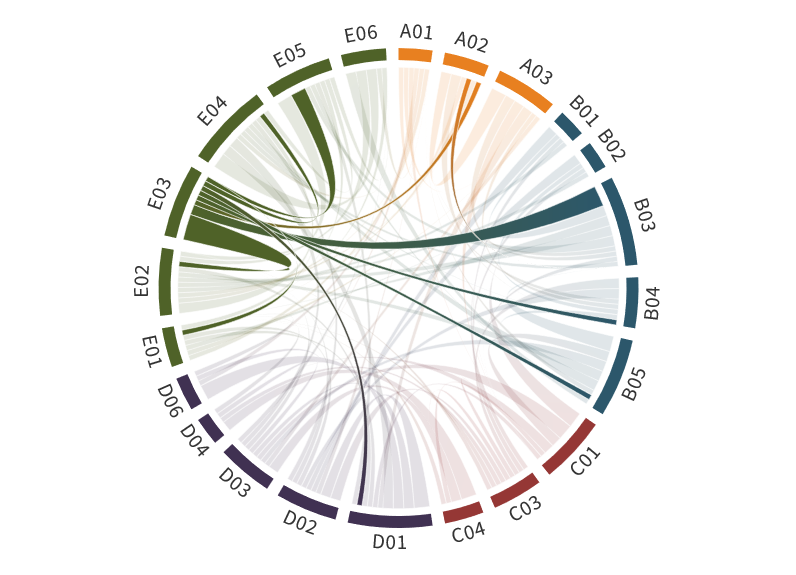
Role within (AC)³
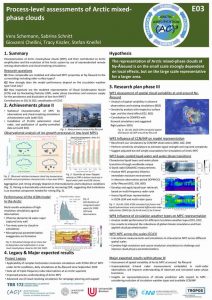
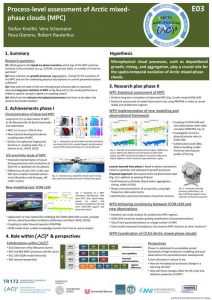
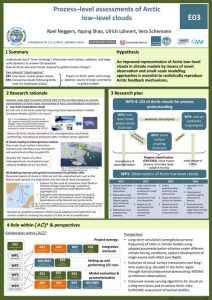
Project Posters
| Phase III Evaluation poster 2023 | Phase II Evaluation poster 2019 | Phase I Evaluation poster 2015 |
 |
 |
 |
Project Members
PhD in E03
Institute for Geophysics and Meteorology (IGM)
University of Cologne
Pohligstr. 3
50969 Cologne
mail:
[email protected]
PhD in E03
Institute for Geophysics and Meteorology (IGM)
University of Cologne
Pohligstr. 3
50969 Cologne
mail:
[email protected]
Project Leader in E03 , Z04
Institute for Geophysics and Meteorology (IGM)
University of Cologne
Pohligstr. 3
50969 Cologne
++49 (0) 221 470 6489
mail:
[email protected]
Project Leader in E03
Institute for Geophysics and Meteorology (IGM)
University of Cologne
Pohligstr. 3
50969 Cologne
++49 (0) 221 470 3690
mail:
[email protected]
Publications
2026
Walbröl, A., Crewell, S., Barrientos-Velasco, C., Chellini, G., Griesche, H. J., Rückert, J. E., and Ebell, K. , 2026: Moisture inversions in the central Arctic: Product assessment and long-wave radiative effect. Q J R Meteorol. Soc, 152(776):e70110, doi:10.1002/qj.70110
2025
Ebell, K., Buhren, C., Gierens, R., Chellini, G., Lauer, M., Walbröl, A., Dahlke, S., Krobot, P., and Mech, M. , July 2025: Impact of weather systems on observed precipitation at Ny-Ålesund (Svalbard). Atmos. Chem Phys, 25(13):7315–7342, doi:10.5194/acp-25-7315-2025
Dorff, H., Ewald, F., Konow, H., Mech, M., Ori, D., Schemann, V., Walbröl, A., Wendisch, M., and Ament, F. , 2025: Moisture budget estimates derived from airborne observations in an Arctic atmospheric river during its dissipation. Atmos. Chem. Phys., 25(14):8329–8354, doi:10.5194/acp-25-8329-2025
Wendisch, M., Kirbus, B., Ori, D., Shupe, M. D., Crewell, S., Sodemann, H., and Schemann, V. , 2025: Observed and modeled Arctic airmass transformations during warm air intrusions and cold air outbreaks. Atmos. Chem. Phys., 25(21):15047–15076, doi:10.5194/acp-25-15047-2025
2024
Kiszler, T., Ori, D., and Schemann, V. , September 2024: Microphysical Processes Involving the Vapour Phase Dominate in Simulated Low-Level Arctic Clouds. Atmos. Chem Phys, 24(17):10039–10053, doi:10.5194/acp-24-10039-2024
Wendisch, M., Crewell, S., Ehrlich, A., Herber, A., Kirbus, B., Lüpkes, C., Mech, M., Abel, S. J., Akansu, E. F., Ament, F., Aubry, C., Becker, S., Borrmann, S., Bozem, H., Brückner, M., Clemen, H., Dahlke, S., Dekoutsidis, G., Delanoë, J., De La Torre Castro, E., Dorff, H., Dupuy, R., Eppers, O., Ewald, F., George, G., Gorodetskaya, I. V., Grawe, S., Groß, S., Hartmann, J., Henning, S., Hirsch, L., Jäkel, E., Joppe, P., Jourdan, O., Jurányi, Z., Karalis, M., Kellermann, M., Klingebiel, M., Lonardi, M., Lucke, J., Luebke, A. E., Maahn, M., Maherndl, N., Maturilli, M., Mayer, B., Mayer, J., Mertes, S., Michaelis, J., Michalkov, M., Mioche, G., Moser, M., Müller, H., Neggers, R., Ori, D., Paul, D., Paulus, F. M., Pilz, C., Pithan, F., Pöhlker, M., Pörtge, V., Ringel, M., Risse, N., Roberts, G. C., Rosenburg, S., Röttenbacher, J., Rückert, J., Schäfer, M., Schaefer, J., Schemann, V., Schirmacher, I., Schmidt, J., Schmidt, S., Schneider, J., Schnitt, S., Schwarz, A., Siebert, H., Sodemann, H., Sperzel, T., Spreen, G., Stevens, B., Stratmann, F., Svensson, G., Tatzelt, C., Tuch, T., Vihma, T., Voigt, C., Volkmer, L., Walbröl, A., Weber, A., Wehner, B., Wetzel, B., Wirth, M., and Zinner, T. , August 2024: Overview: Quasi-Lagrangian Observations of Arctic Air Mass Transformations – Introduction and Initial Results of the HALO–(A C)\textsuperscript3 Aircraft Campaign. Atmos. Chem Phys, 24(15):8865–8892, doi:10.5194/acp-24-8865-2024
Schirmacher, I., Schnitt, S., Klingebiel, M., Maherndl, N., Kirbus, B., Ehrlich, A., Mech, M., and Crewell, S. Clouds and Precipitation in the Initial Phase of Marine Cold Air Outbreaks as Observed by Airborne Remote Sensing. April 2024. doi:10.5194/egusphere-2024-850.
Chellini, G. and Kneifel, S. , March 2024: Turbulence as a Key Driver of Ice Aggregation and Riming in Arctic Low-Level Mixed-Phase Clouds, Revealed by Long-Term Cloud Radar Observations. Geophys. Res. Lett., 51(6):e2023GL106599, doi:10.1029/2023GL106599
Schnitt, S., Foth, A., Kalesse-Los, H., Mech, M., Acquistapace, C., Jansen, F., Löhnert, U., Pospichal, B., Röttenbacher, J., Crewell, S., and Stevens, B. , January 2024: Ground- and Ship-Based Microwave Radiometer Measurements during EUREC\textsuperscript4 A. Earth Syst. Sci. Data, 16(1):681–700, doi:10.5194/essd-16-681-2024
2023
Chellini, G., Gierens, R., Ebell, K., Kiszler, T., Krobot, P., Myagkov, A., Schemann, V., and Kneifel, S. , December 2023: Low-Level Mixed-Phase Clouds at the High Arctic Site of Ny-Ålesund: A Comprehensive Long-Term Dataset of Remote Sensing Observations. Earth Syst. Sci. Data, 15(12):5427–5448, doi:10.5194/essd-15-5427-2023
Kiszler, T., Ebell, K., and Schemann, V. , May 2023: A Performance Baseline for the Representation of Clouds and Humidity in Cloud-Resolving ICON-LEM Simulations in the Arctic. J. Adv. Model. Earth Syst., 15(5):e2022MS003299, doi:10.1029/2022MS003299
2022
Pasquier, J. T., Henneberger, J., Ramelli, F., Lauber, A., David, R. O., Wieder, J., Carlsen, T., Gierens, R., Maturilli, M., and Lohmann, U. , December 2022: Conditions Favorable for Secondary Ice Production in Arctic Mixed-Phase Clouds. Atmos. Chem Phys, 22(23):15579–15601, doi:10.5194/acp-22-15579-2022
Chellini, G., Gierens, R., and Kneifel, S. , August 2022: Ice Aggregation in Low-Level Mixed-Phase Clouds at a High Arctic Site: Enhanced by Dendritic Growth and Absent Close to the Melting Level. J. Geophys. Res. Atmospheres, 127(16):e2022JD036860, doi:10.1029/2022JD036860
2021
2020
Rauterkus, R. and Ansorge, C. , December 2020: Cloud-Top Entrainment in Mixed-Phase Stratocumulus and Its Process-Level Representation in Large-Eddy Simulation. J. Atmospheric Sci., 77(12):4109–4127, doi:10.1175/JAS-D-19-0221.1
Karrer, M., Seifert, A., Siewert, C., Ori, D., Von Lerber, A., and Kneifel, S. , August 2020: Ice Particle Properties Inferred From Aggregation Modelling. J. Adv. Model. Earth Syst., 12(8):e2020MS002066, doi:10.1029/2020MS002066
Gierens, R., Kneifel, S., Shupe, M. D., Ebell, K., Maturilli, M., and Löhnert, U. , March 2020: Low-Level Mixed-Phase Clouds in a Complex Arctic Environment. Atmos. Chem Phys, 20(6):3459–3481, doi:10.5194/acp-20-3459-2020
Schemann, V. and Ebell, K. , January 2020: Simulation of Mixed-Phase Clouds with the ICON Large-Eddy Model in the Complex Arctic Environment around Ny-Ålesund. Atmos. Chem Phys, 20(1):475–485, doi:10.5194/acp-20-475-2020
2019
2018
Leinonen, J., Kneifel, S., and Hogan, R. J. , November 2018: Evaluation of the Rayleigh–Gans Approximation for Microwave Scattering by Rimed Snowflakes. Q. J. R. Meteorol. Soc., 144(S1):77–88, doi:10.1002/qj.3093
2017
Küchler, N., Kneifel, S., Löhnert, U., Kollias, P., Czekala, H., and Rose, T. , November 2017: A W-Band Radar–Radiometer System for Accurate and Continuous Monitoring of Clouds and Precipitation. J Atmos. Ocean Technol, 34(11):2375–2392, doi:10.1175/JTECH-D-17-0019.1


 .
.