
Project Leaders: Torsten Kanzow, Marc Salzmann (former PLs: Rüdiger Gerdes)


Warm water of Atlantic Ocean origin is advected into the Arctic Ocean. This water has been warming over the past decades and it has been gaining in importance in melting Arctic sea ice. Recently, we could show that the decadal forcing of heat transport into the Barents Sea Opening is linked to both a wind forcing pattern extending along the Norwegian coast associated with the North Atlantic Oscillation (NAO) and to another distinct pattern centered around Svalbard. We were able to demonstrate that the pronounced sea ice decline in the Northern Barents Sea over the past decades has been associated with the development of a local, cyclonic wind anomaly, driven by increased sea-to-air heat fluxes. This anomaly has left the heat transport into Barents Sea Opening relatively unchanged, yet, it has decreased the amount of Atlantic Water flowing into the Arctic Ocean via Fram Strait. At the same time, we found CMIP5 multi-model projections for a high emission Greenhouse gas scenario to show strongly increasing sea-to-air heat fluxes toward the end of this century along the pathway of the Arctic Boundary Current in winter – confirming the concept of Atlantification.
Building on our results from phase II, in phase III we will quantify the contribution of ocean heat transport through the Arctic Gateways in driving the observed variability of Arctic sea ice over the past few decades using AWI’s coupled climate model (AWI-CM). We will further work towards understanding the redistribution of heat by ocean circulation and stratification within the Arctic Ocean, so that it becomes available for melting sea ice and warming the atmospheric boundary layer. To this end, we plan to employ tracer diagnostics to assess transport and vertical mixing in the ocean component of AWI-CM. We will investigate potential relationships between simulated tracer distributions and Arctic amplification in AWI-CM and CMIP6 models. We will investigate shortcomings in the current CMIP framework by misrepresentation of upper-ocean mesoscale processes. Using AWI-CM, we will infer how an increased realism in the representation ocean dynamics affects upward heat transport and trends in sea ice in the entire Arctic domain until the end of this century. We expect major sensitivities in vertical and orizontal heat fluxes along the inflow pathways of warm water, which are the areas mostly affected by Atlantification today, coinciding with areas of maximum sea ice retreat in winter. The last step will be to study sensitivities in atmospheric feedback mechanisms in AWI-CM relative to the realism in the representation ocean dynamics. In particular, we expect the horizontal distribution of the intensity of the lapse rate feedback to be largely governed by the vertical ocean heat fluxes and ice cover.
Hypothesis:
Ocean heat transport is becoming increasingly important for Arctic amplification and is coupled to atmospheric dynamics and sea ice decline.
Specific questions we want to answer:
- To what extent does ocean heat transport control changes in observed sea ice extent and air sea heat fluxes?
- What is the recent and future evolution of horizontal and vertical ocean transport processes within the Arctic Ocean?
- How do ocean heat transport processes contribute to future Arctic warming?
Our goal to quantify atmospheric feedback sensitivity to ocean processes represents an important element of SQ1. Our study of impacts of ocean heat transports through the Arctic gateways targets the most important ocean connection between the midlatitudes and the Arctic Ocean, and ideally contributes to SQ2. Thirdly, our work on both climate model projections and recent changes in the Arctic is a fundamental element of SQ3. Our study thus contributes to all three SQs of (AC)³.
Role within (AC)³
Project Posters
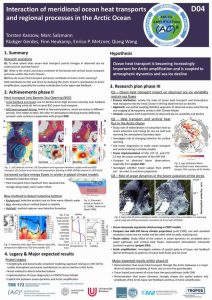
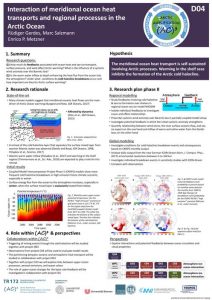
| Phase III Evaluation poster 2023 | Phase II Evaluation poster 2019 | |
 |
 |
Project Members

PhD in D04
Leipzig Institute for Meteorology (LIM)
University of Leipzig
Stephanstr. 3
04103 Leipzig
++49 (0) 341 97 32940
mail:
[email protected]

Project Leader in C04 , D04
Alfred-Wegener-Insitute Helmholtz Center for Polar and Marine Research (AWI)
Bussestraße 24
27570 Bremerhaven
will follow
mail:
[email protected]
Project Leader in D04
Leipzig Institute for Meteorology (LIM)
University of Leipzig
Stephanstr. 3
04103 Leipzig
++49 (0) 341 97 32932
mail:
[email protected]
PhD in D04
Alfred-Wegener-Insitute Helmholtz Center for Polar and Marine Research (AWI)
Bussestraße 24
27570 Bremerhaven
will follow
mail:
[email protected]
Publications
2026
2025
Heukamp, F. O., Wekerle, C., Kanzow, T., McPherson, R., and Baumann, T. M. , June 2025: Atlantic water recirculation in the northern Barents Sea affects winter sea ice extent. Nat. Commun., doi:10.1038/s41467-025-59992-9
2024
McPherson, R. A., Wekerle, C., Kanzow, T., Ionita, M., Heukamp, F. O., Zeising, O., and Humbert, A. , September 2024: Atmospheric Blocking Slows Ocean-Driven Melting of Greenland's Largest Glacier Tongue. Science, 385(6715):1360–1366, doi:10.1126/science.ado5008
2023
Metzner, E. P. and Salzmann, M. , October 2023: Technical Note: Determining Arctic Ocean Halocline and Cold Halostad Depths Based on Vertical Stability. Ocean Sci., 19(5):1453–1464, doi:10.5194/os-19-1453-2023
Heukamp, F. O., Aue, L., Wang, Q., Ionita, M., Kanzow, T., Wekerle, C., and Rinke, A. , September 2023: Cyclones Modulate the Control of the North Atlantic Oscillation on Transports into the Barents Sea. Commun Earth Env., 4(1):324, doi:10.1038/s43247-023-00985-1
Hajjar, K. A. and Salzmann, M. , July 2023: Relative Contributions of Local Heat Storage and Ocean Heat Transport to Cold-season Arctic Ocean Surface Energy Fluxes in CMIP6 Models. Q. J. R. Meteorol. Soc., 149(755):2091–2106, doi:10.1002/qj.4496
Heukamp, F. O., Kanzow, T., Wang, Q., Wekerle, C., and Gerdes, R. , March 2023: Impact of Cyclonic Wind Anomalies Caused by Massive Winter Sea Ice Retreat in the Barents Sea on Atlantic Water Transport Toward the Arctic: A Model Study. J. Geophys. Res. Oceans, 128(3):e2022JC019045, doi:10.1029/2022JC019045
2022
Salzmann, M., Ferrachat, S., Tully, C., Münch, S., Watson-Parris, D., Neubauer, D., Siegenthaler-Le Drian, C., Rast, S., Heinold, B., Crueger, T., Brokopf, R., Mülmenstädt, J., Quaas, J., Wan, H., Zhang, K., Lohmann, U., Stier, P., and Tegen, I. , April 2022: The Global Atmosphere-aerosol Model ICON-A-HAM2.3–Initial Model Evaluation and Effects of Radiation Balance Tuning on Aerosol Optical Thickness. J. Adv. Model. Earth Syst., 14(4):e2021MS002699, doi:10.1029/2021MS002699
2021
2020
Kovács, T., Gerdes, R., and Marshall, J. , August 2020: Wind Feedback Mediated by Sea Ice in the Nordic Seas. J. Clim., 33(15):6621–6632, doi:10.1175/JCLI-D-19-0632.1
Metzner, E. P., Salzmann, M., and Gerdes, R. , February 2020: Arctic Ocean Surface Energy Flux and the Cold Halocline in Future Climate Projections. J. Geophys. Res. Oceans, 125(2):e2019JC015554, doi:10.1029/2019JC015554
2019
Muilwijk, M., Ilicak, M., Cornish, S. B., Danilov, S., Gelderloos, R., Gerdes, R., Haid, V., Haine, T. W. N., Johnson, H. L., Kostov, Y., Kovács, T., Lique, C., Marson, J. M., Myers, P. G., Scott, J., Smedsrud, L. H., Talandier, C., and Wang, Q. , August 2019: Arctic Ocean Response to Greenland Sea Wind Anomalies in a Suite of Model Simulations. J. Geophys. Res. Oceans, 124(8):6286–6322, doi:10.1029/2019JC015101


 .
.