
Project Leaders: Holger Siebert, Manfred Wendisch

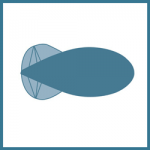
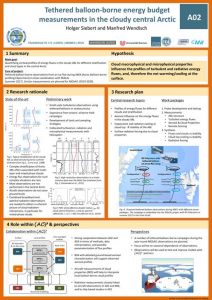
This project builds on the successful balloon-borne measurements in phases I and II of (AC)³. As a major achievement, we have compiled a comprehensive set of data consisting of combined thermodynamic, turbulence, radiation, and aerosol/cloud properties. The data were collected in cloudless and cloudy conditions over Arctic sea ice and snow-covered land surface. They were assembled with partly newly developed instruments carried by tethered balloons during several campaigns. As a first step, the measurements enabled to derive more accurate surface layer mixing (SML) heights during polar night. Furthermore, important conclusions were drawn about the effects of entrainment of humid air at the top of clouds, the suppression of turbulence generated by cloud top radiative cooling in the lower cloud of a multi-layer cloud system, and the footprints of air mass characteristics in measured thermodynamic and aerosol/cloud profiles. First case studies observing the transition processes (cloud formation and decay, low-level jet (LLJ) formation) and comparative studies between polar night and day were conducted. However, the complexity of the balloon operations limited the continuity of profiling, which partially prevented an in-depth evaluation of the observed transition processes. Furthermore, it became increasingly obvious that the interpretation of the measurements would benefit greatly from an own additional modeling component.
Therefore, we propose to use smaller balloons with more compact payloads in phase III to increase flexibility and enable profile measurements over extended periods with a 5-minutes interval between the profiles. This will facilitate to study the important transitions between typical states of the Arctic atmospheric boundary layer (ABL) in, so far, unprecedented temporal resolution. To obtain the required measurements, we suggest a four-week campaign in North-East Greenland (Villum Station, Station Nord). In addition, we propose to apply a sophisticated large eddy simulation (LES) model and a single-column model (SCM) to quantify the ability of the models to adequately represent the transition processes, to identify corresponding weaknesses, and to perform dedicated process studies. The LES fully resolves the dynamical boundary layer processes on larger scales, but is more complex to operate and computationally expensive. The SCM is less complicated to run, it is fast, and can be used for inexpensive parameterization testing and sensitivity studies. Furthermore, we plan to include ICON simulations in weather forecast mode in coarser temporal resolution. These ICON runs will cover the entire measurement period of the proposed campaign in Greenland and will be used to assess the transition from polar night to polar day. Finally, the measurement and modeling efforts proposed in this project will be applied to quantify the impact of changes of the ABL structure and height during the three state transitions investigated in our project on the surface warming via the lapse rate feedback.
Hypothesis:
Highly resolved profile data of the Arctic ABL are needed to realistically simulate typical ABL transition processes and to investigate their effects on the lapse rate feedback.
Specific questions:
- How do measured profiles of thermodynamic, turbulence, radiative, and aerosol properties evolve during the transition from cloudless to cloudy conditions and during the formation of LLJs, and how well can these non-steady transformations be modeled by LES and SCMs?
- How well does ICON in weather forecast mode represent the transition period from polar night to day, and can possible model deficiencies in this regard be resolved?
- How do stability, temperature lapse rate, inversion height/strength, vertical humidity and cloud distributions influence the surface warming and the lapse rate feedback in cloudless and cloudy situations?
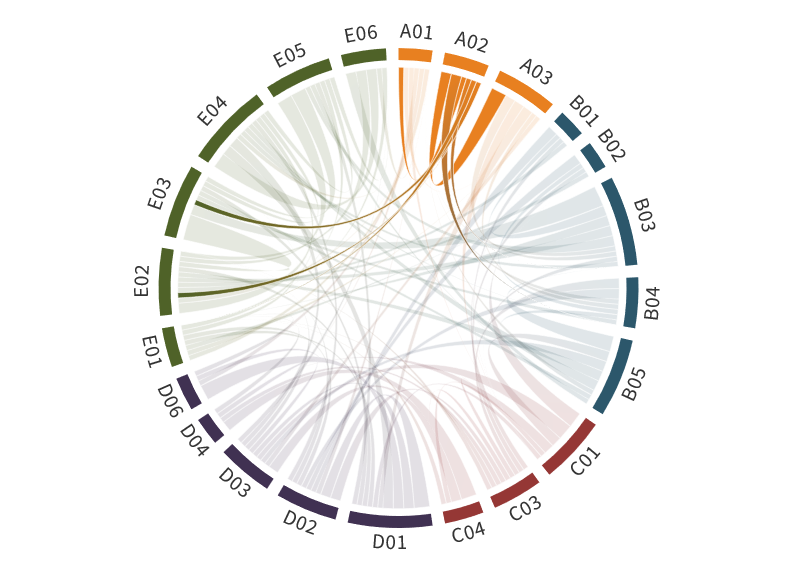
Arctic amplification appears most pronounced in winter, when particularly distinct near-surface air temperature and humidity inversions, and related shallow ABLs develop. With the profile measurements and simulations proposed in this project we will investigate how these ABL specifics and their changes during typical transformation processes influence the lapse rate feedback as one of the major drivers of Arctic amplification. Thus, we will contribute to the understanding and quantification of the lapse rate feedback for near-surface warming in winter. In this way, the project will contribute to answer SQ1.
Achievements phase II
- Generation of a comprehensive data set of thermodynamic, turbulence, radiation, and aerosol/cloud parameter profiles , with a significant portion collected during polar night (Lonardi et al., 2022; Akansu et al., 2023a,
- More accurate estimation of SML heights during the polar night from vertically resolved direct turbulence observations (Akansu et al., 2023a),
- Verification of the effects of entrainment of humid air at the top of clouds on their lifetime (Egerer et al., 2021; Neggers et al., 2019)
- Approval of the effect of suppression of turbulence (generated by cloud top radiative cooling) in the lower cloud of a multi-layer cloud system due to shadowing effects (Lonardi et al., 2022)
- Detection of signatures of air mass characteristics imprinted in the measured profiles of aerosol, radiation, and meteorological parameters (Pilz et al., 2023)
- Development of a new method for estimating turbulent fluxes (Egerer et al., 2023a)
- Investigation of the potential role of a LLJ for long-range transport (Egerer et al., 2023b).
Achievements phase I
A02 developed a novel instrumental payload carried by a tethered balloon. The Balloon-bornE moduLar Utility for proilinG the lower Atmosphere (BELUGA) system was applied on the sea ice camp during PASCAL (Knudsen et al., 2018b); Wendisch et al., 2019; Egerer et al., 2019). Humidity inversions just above cloud top have been discovered by the balloon measurements and verified by LES results (Neggers et al., 2019). With these data, the entrainment of moisture into the cloud was investigated. Furthermore, it was shown that cloud top cooling efficiently drives turbulence. In case of multi-layer clouds, the cloud top cooling of the lower cloud is significantly suppressed.
Role within (AC)³
Project Posters
| Phase III Evaluation poster 2023 | Phase II Evaluation poster 2019 | Phase I Evaluation poster 2015 |
 |
 |
 |
Project Members
mail:
[email protected]
Project Leader in A02
Leibniz Institute for Tropospheric Research (TROPOS)
Permoserstr. 15
04318 Leipzig
++49 (0) 341 2717 7145
mail:
[email protected]
Publications
2026
Shupe, M. D., Persson, P. O. G., Cox, C. J., Gallagher, M. R., Solomon, A., Sledd, A., Blomquist, B., Brooks, I. M., Costa, D., Osborn, J., Perovich, D., Riihimaki, L. D., and Uttal, T. , 2026: The two radiative states of the Arctic atmosphere and their impacts on the surface energy budget of sea ice. Elem. Sci. Anth., 14(1):00100, doi:10.1525/elementa.2025.00100
Dorff, H., Siebert, H., Navale, K., Ehrlich, A., Müller, J., Schäfer, M., Wu, F., and Wendisch, M. , 2026: Tethered balloon-borne measurements to characterise the evolution of the Arctic atmospheric boundary layer at the Villum Research Station. Earth Syst. Sci. Data, 18(4):2799–2817, doi:10.5194/essd-18-2799-2026
Zeppenfeld, S., Schaefer, J., Pilz, C., Ebell, K., Zeising, M., Stratmann, F., Siebert, H., Wehner, B., Wietz, M., Bracher, A., and van Pinxteren, M. , 2026: Marine carbohydrates and other sea spray aerosol constituents across altitudes in the lower troposphere of Ny-Ålesund, Svalbard. Atmos. Chem. Phys., 26(10):7235–7260, doi:10.5194/acp-26-7235-2026
2025
Seidel, C., Althausen, D., Ansmann, A., Wendisch, M., Griesche, H., Radenz, M., Hofer, J., Dahlke, S., Maturilli, M., Walbröl, A., Baars, H., and Engelmann, R. , April 2025: Close correlation between vertically integrated tropospheric water vapor and the downward, broadband thermal-infrared irradiance at the ground: Observations in the central arctic during MOSAiC. J Geophys Res-Atmos., doi:10.1029/2024JD042378
Dorff, H., Ewald, F., Konow, H., Mech, M., Ori, D., Schemann, V., Walbröl, A., Wendisch, M., and Ament, F. , 2025: Moisture budget estimates derived from airborne observations in an Arctic atmospheric river during its dissipation. Atmos. Chem. Phys., 25(14):8329–8354, doi:10.5194/acp-25-8329-2025
Karalis, M., Svensson, G., Wendisch, M., and Tjernström, M. , 2025: Lagrangian single-column modeling of Arctic air mass transformation during HALO-(AC)$^3$. Atmos. Chem. Phys., 25(20):13177–13198, doi:10.5194/acp-25-13177-2025
2024
Wendisch, M., Crewell, S., Ehrlich, A., Herber, A., Kirbus, B., Lüpkes, C., Mech, M., Abel, S. J., Akansu, E. F., Ament, F., Aubry, C., Becker, S., Borrmann, S., Bozem, H., Brückner, M., Clemen, H., Dahlke, S., Dekoutsidis, G., Delanoë, J., De La Torre Castro, E., Dorff, H., Dupuy, R., Eppers, O., Ewald, F., George, G., Gorodetskaya, I. V., Grawe, S., Groß, S., Hartmann, J., Henning, S., Hirsch, L., Jäkel, E., Joppe, P., Jourdan, O., Jurányi, Z., Karalis, M., Kellermann, M., Klingebiel, M., Lonardi, M., Lucke, J., Luebke, A. E., Maahn, M., Maherndl, N., Maturilli, M., Mayer, B., Mayer, J., Mertes, S., Michaelis, J., Michalkov, M., Mioche, G., Moser, M., Müller, H., Neggers, R., Ori, D., Paul, D., Paulus, F. M., Pilz, C., Pithan, F., Pöhlker, M., Pörtge, V., Ringel, M., Risse, N., Roberts, G. C., Rosenburg, S., Röttenbacher, J., Rückert, J., Schäfer, M., Schaefer, J., Schemann, V., Schirmacher, I., Schmidt, J., Schmidt, S., Schneider, J., Schnitt, S., Schwarz, A., Siebert, H., Sodemann, H., Sperzel, T., Spreen, G., Stevens, B., Stratmann, F., Svensson, G., Tatzelt, C., Tuch, T., Vihma, T., Voigt, C., Volkmer, L., Walbröl, A., Weber, A., Wehner, B., Wetzel, B., Wirth, M., and Zinner, T. , August 2024: Overview: Quasi-Lagrangian Observations of Arctic Air Mass Transformations – Introduction and Initial Results of the HALO–(A C)\textsuperscript3 Aircraft Campaign. Atmos. Chem Phys, 24(15):8865–8892, doi:10.5194/acp-24-8865-2024
Pilz, C., Cassano, J. J., De Boer, G., Kirbus, B., Lonardi, M., Pöhlker, M., Shupe, M. D., Siebert, H., Wendisch, M., and Wehner, B. , May 2024: Tethered Balloon Measurements Reveal Enhanced Aerosol Occurrence Aloft Interacting with Arctic Low-Level Clouds. Elem Sci Anth, 12(1):00120, doi:10.1525/elementa.2023.00120
Paulus, F. M., Karalis, M., George, G., Svensson, G., Wendisch, M., and Neggers, R. A. J. , 2024: Airborne measurements of mesoscale divergence at high latitudes during HALO–(AC)3. J. Atmos. Sci., 81(12):2051–2067, doi:10.1175/JAS-D-24-0034.1
2023
Egerer, U., Siebert, H., Hellmuth, O., and Sørensen, L. L. , December 2023: The Role of a Low-Level Jet for Stirring the Stable Atmospheric Surface Layer in the Arctic. Atmos. Chem Phys, 23(24):15365–15373, doi:10.5194/acp-23-15365-2023
Akansu, E. F., Dahlke, S., Siebert, H., and Wendisch, M. , December 2023: Evaluation of Methods to Determine the Surface Mixing Layer Height of the Atmospheric Boundary Layer in the Central Arctic during Polar Night and Transition to Polar Day in Cloudless and Cloudy Conditions. Atmos. Chem Phys, 23(24):15473–15489, doi:10.5194/acp-23-15473-2023
Akansu, E. F., Siebert, H., Dahlke, S., Graeser, J., Jaiser, R., and Sommerfeld, A. , October 2023: Tethered Balloon-Borne Turbulence Measurements in Winter and Spring during the MOSAiC Expedition. Sci. Data, 10(1):723, doi:10.1038/s41597-023-02582-5
Pilz, C., Lonardi, M., Egerer, U., Siebert, H., Ehrlich, A., Heymsfield, A. J., Schmitt, C. G., Shupe, M. D., Wehner, B., and Wendisch, M. , August 2023: Profile Observations of the Arctic Atmospheric Boundary Layer with the BELUGA Tethered Balloon during MOSAiC. Sci. Data, 10(1):534, doi:10.1038/s41597-023-02423-5
Lonardi, M., Akansu, E. F., Ehrlich, A., Mazzola, M., Pilz, C., Shupe, M. D., Siebert, H., and Wendisch, M. Tethered Balloon-Borne Observations of Thermal-Infrared Irradiance and Cooling Rate Profiles in the Arctic Atmospheric Boundary Layer. July 2023. doi:10.5194/egusphere-2023-1396.
Egerer, U., Cassano, J. J., Shupe, M. D., De Boer, G., Lawrence, D., Doddi, A., Siebert, H., Jozef, G., Calmer, R., Hamilton, J., Pilz, C., and Lonardi, M. , May 2023: Estimating Turbulent Energy Flux Vertical Profiles from Uncrewed Aircraft System Measurements: Exemplary Results for the MOSAiC Campaign. Atmos. Meas Tech, 16(8):2297–2317, doi:10.5194/amt-16-2297-2023
2022
Pilz, C., Düsing, S., Wehner, B., Müller, T., Siebert, H., Voigtländer, J., and Lonardi, M. , December 2022: CAMP: An Instrumented Platform for Balloon-Borne Aerosol Particle Studies in the Lower Atmosphere. Atmos. Meas Tech, 15(23):6889–6905, doi:10.5194/amt-15-6889-2022
Lonardi, M., Pilz, C., Akansu, E. F., Dahlke, S., Egerer, U., Ehrlich, A., Griesche, H., Heymsfield, A. J., Kirbus, B., Schmitt, C. G., Shupe, M. D., Siebert, H., Wehner, B., and Wendisch, M. , September 2022: Tethered Balloon-Borne Profile Measurements of Atmospheric Properties in the Cloudy Atmospheric Boundary Layer over the Arctic Sea Ice during MOSAiC: Overview and First Results. Elem. Sci. Anthr., 10(1):000120, doi:10.1525/elementa.2021.000120
Shupe, M. D., Rex, M., Blomquist, B., Persson, P. O. G., Schmale, J., Uttal, T., Althausen, D., Angot, H., Archer, S., Bariteau, L., Beck, I., Bilberry, J., Bucci, S., Buck, C., Boyer, M., Brasseur, Z., Brooks, I. M., Calmer, R., Cassano, J., Castro, V., Chu, D., Costa, D., Cox, C. J., Creamean, J., Crewell, S., Dahlke, S., Damm, E., De Boer, G., Deckelmann, H., Dethloff, K., Dütsch, M., Ebell, K., Ehrlich, A., Ellis, J., Engelmann, R., Fong, A. A., Frey, M. M., Gallagher, M. R., Ganzeveld, L., Gradinger, R., Graeser, J., Greenamyer, V., Griesche, H., Griffiths, S., Hamilton, J., Heinemann, G., Helmig, D., Herber, A., Heuzé, C., Hofer, J., Houchens, T., Howard, D., Inoue, J., Jacobi, H., Jaiser, R., Jokinen, T., Jourdan, O., Jozef, G., King, W., Kirchgaessner, A., Klingebiel, M., Krassovski, M., Krumpen, T., Lampert, A., Landing, W., Laurila, T., Lawrence, D., Lonardi, M., Loose, B., Lüpkes, C., Maahn, M., Macke, A., Maslowski, W., Marsay, C., Maturilli, M., Mech, M., Morris, S., Moser, M., Nicolaus, M., Ortega, P., Osborn, J., Pätzold, F., Perovich, D. K., Petäjä, T., Pilz, C., Pirazzini, R., Posman, K., Powers, H., Pratt, K. A., Preußer, A., Quéléver, L., Radenz, M., Rabe, B., Rinke, A., Sachs, T., Schulz, A., Siebert, H., Silva, T., Solomon, A., Sommerfeld, A., Spreen, G., Stephens, M., Stohl, A., Svensson, G., Uin, J., Viegas, J., Voigt, C., Von Der Gathen, P., Wehner, B., Welker, J. M., Wendisch, M., Werner, M., Xie, Z., and Yue, F. , February 2022: Overview of the MOSAiC Expedition: Atmosphere. Elem Sci Anth, 10(1):00060, doi:10.1525/elementa.2021.00060
2021
Egerer, U., Ehrlich, A., Gottschalk, M., Griesche, H., Neggers, R. A. J., Siebert, H., and Wendisch, M. , April 2021: Case Study of a Humidity Layer above Arctic Stratocumulus and Potential Turbulent Coupling with the Cloud Top. Atmos. Chem Phys, 21(8):6347–6364, doi:10.5194/acp-21-6347-2021
2020
2019
Ehrlich, A., Wendisch, M., Lüpkes, C., Buschmann, M., Bozem, H., Chechin, D., Clemen, H., Dupuy, R., Eppers, O., Hartmann, J., Herber, A., Jäkel, E., Järvinen, E., Jourdan, O., Kästner, U., Kliesch, L., Köllner, F., Mech, M., Mertes, S., Neuber, R., Ruiz-Donoso, E., Schnaiter, M., Schneider, J., Stapf, J., and Zanatta, M. , November 2019: A Comprehensive in Situ and Remote Sensing Data Set from the Arctic CLoud Observations Using Airborne Measurements during Polar Day (ACLOUD) Campaign. Earth Syst. Sci. Data, 11(4):1853–1881, doi:10.5194/essd-11-1853-2019
Egerer, U., Gottschalk, M., Siebert, H., Ehrlich, A., and Wendisch, M. , July 2019: The New BELUGA Setup for Collocated Turbulence and Radiation Measurements Using a Tethered Balloon: First Applications in the Cloudy Arctic Boundary Layer. Atmos. Meas Tech, 12(7):4019–4038, doi:10.5194/amt-12-4019-2019
Wendisch, M., Macke, A., Ehrlich, A., Lüpkes, C., Mech, M., Chechin, D., Dethloff, K., Velasco, C. B., Bozem, H., Brückner, M., Clemen, H., Crewell, S., Donth, T., Dupuy, R., Ebell, K., Egerer, U., Engelmann, R., Engler, C., Eppers, O., Gehrmann, M., Gong, X., Gottschalk, M., Gourbeyre, C., Griesche, H., Hartmann, J., Hartmann, M., Heinold, B., Herber, A., Herrmann, H., Heygster, G., Hoor, P., Jafariserajehlou, S., Jäkel, E., Järvinen, E., Jourdan, O., Kästner, U., Kecorius, S., Knudsen, E. M., Köllner, F., Kretzschmar, J., Lelli, L., Leroy, D., Maturilli, M., Mei, L., Mertes, S., Mioche, G., Neuber, R., Nicolaus, M., Nomokonova, T., Notholt, J., Palm, M., Van Pinxteren, M., Quaas, J., Richter, P., Ruiz-Donoso, E., Schäfer, M., Schmieder, K., Schnaiter, M., Schneider, J., Schwarzenböck, A., Seifert, P., Shupe, M. D., Siebert, H., Spreen, G., Stapf, J., Stratmann, F., Vogl, T., Welti, A., Wex, H., Wiedensohler, A., Zanatta, M., and Zeppenfeld, S. , May 2019: The Arctic Cloud Puzzle: Using ACLOUD/PASCAL Multiplatform Observations to Unravel the Role of Clouds and Aerosol Particles in Arctic Amplification. Bull. Am. Meteorol. Soc., 100(5):841–871, doi:10.1175/BAMS-D-18-0072.1


 .
.