
Project Leaders: Marlene Kretschmer


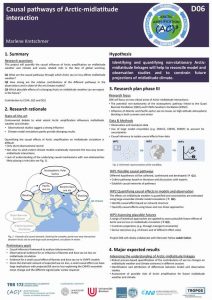
This project aims to make progress in understanding and quantifying the causal influence of Arctic amplification on midlatitude weather and climate and to assess related risks in the face of global warming.
To achieve this goal, different pathways proposed in the literature linking Arctic changes with midlatitude weather will be studied. We will focus on the two-way interactions of Arctic sea ice loss and atmospheric blocking, as well as on potential non-stationarities of the influence of Barents and Kara sea ice loss on midlatitude circulation via the stratospheric polar vortex. The proposed pathways will be presented in the form of causal networks, which will guide the further data analysis. We will follow causal inference theory to quantify the pathways in the causal networks using climate simulations and observations. Particularly, we will capitalize on available single model initial-condition large ensembles to understand if differences between model results and observations and across different models can be attributed to sampling uncertainty, or whether they stem from systematic model biases. This comparison of observed and modeled linkages between the Arctic and the midlatitudes will pave the way to constrain projections of the effects of Arctic sea ice loss on midlatitude weather and climate, including extreme events. To assess the plausible risks caused by future sea ice loss, we will finally apply a storyline approach, which decomposes projection uncertainties to the behavior of their dynamical drivers.
Hypothesis:
Identifying and quantifying non-stationary Arctic-midlatitude linkages will help to reconcile model and observation studies and to constrain future projections of midlatitude climate.
Specific questions we want to answer:
- What are the causal pathways through which Arctic sea ice loss affects midlatitude weather?
- How strong are the relative contributions of the different pathways in the observations and in state-of-the art climate models?
- Which plausible effects of a changing Arctic on midlatitude weather can we expect in the future?
This project directly contributes to the strategic question SQ2 through quantifying the causal effect of Arctic changes on midlatitude weather, and to SQ3 by assessing plausible future effects of Arctic sea ice loss on midlatitude circulation.
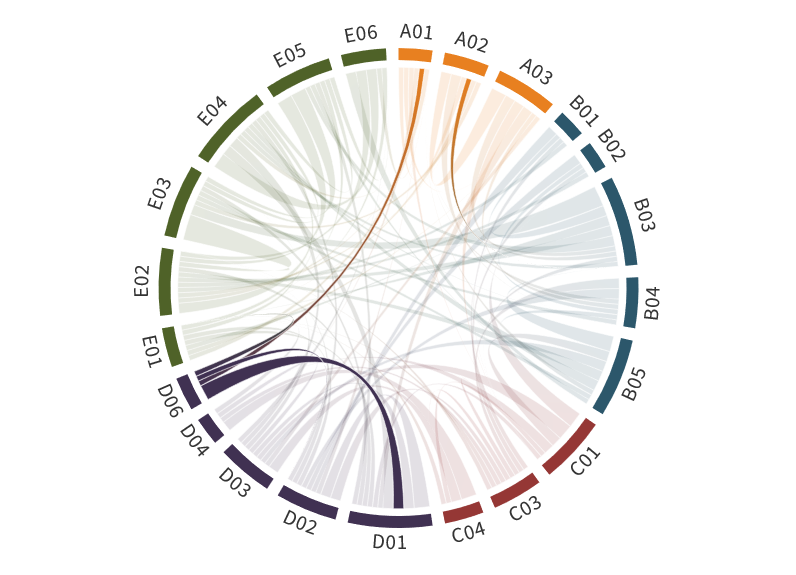
Role within (AC)³
Project Posters
| Phase III Evaluation poster 2023 | ||
 |
Project Members

PhD in D06
Leipzig Institute for Meteorology (LIM)
University of Leipzig
Stephanstr. 3
04103 Leipzig
mail:
[email protected]
PhD in D06
Leipzig Institute for Meteorology (LIM)
University of Leipzig
Stephanstr. 3
04103 Leipzig
mail:
[email protected]
Project Leader in D06
Leipzig Insitute for Meteorology (LIM)
University of Leipzig
Talstraße 35
04103 Leipzig
++49 (0) 341 9732846
mail:
[email protected]
Publications
2026
Swain, B., Vountas, M., Singh, A., Panda, U., Song, R., Anchan, N. L., Malasani, C. R., Mallick, D., Alawode, R., Deroubaix, A., Lelli, L., Schmale, J., Tandon, A., Gunthe, S. S., Wendisch, M., Hari, V., and Bösch, H. , 2026: Contrasting anthropogenic drivers behind asymmetric warming in the arctic and antarctica. Ocean-Land-Atmos. Res., 5:0127, doi:10.34133/olar.0127
2025
Shen, X., Kretschmer, M., and Shepherd, T. G. , August 2025: Quantifying the state-dependent causal effect of Barents-Kara Sea ice loss on the stratospheric polar vortex in a large ensemble simulation. Clim. Dyn., doi:10.1007/s00382-025-07802-9
Swain, B., Vountas, M., Singh, A., Anchan, N. L., Malasani, C. R., Mallick, D., Deroubaix, A., Lelli, L., Patel, N., Alawode, R., Gunthe, S. S., Grainger, R. G., Schmale, J., Hari, V., Kokhanovsky, A., Wendisch, M., Bösch, H., and Burrows, J. P. , March 2025: Insights of Aerosol-Precipitation Nexus in the Central Arctic through CMIP6 Climate Models. Npj Clim Atmos. Sci, 8(1):103, doi:10.1038/s41612-025-00957-6
Cosford, L. R., Ghosh, R., Kretschmer, M., Oatley, C., and Shepherd, T. G. , March 2025: Estimating the Contribution of Arctic Sea-Ice Loss to Central Asia Temperature Anomalies: The Case of Winter 2020/2021. Environ. Res. Lett., 20(3):034007, doi:10.1088/1748-9326/adae22


 .
.