
Arctic CLoud Observations Using airborne measurements during polar Day May 22 to June 28 2017, Longyearbyen/Svalbard |

|
Scientific Objectives
| ACLOUD is a joint project of different German universities and research institutes embedded in the Transregional Collaborative Research Centre TR 172: ArctiC Amplification: Climate Relevant Atmospheric and SurfaCe Processes, and Feedback Mechanisms (AC)³. The general goal of ACLOUD is to obtain a comprehensive data set of a diversity of atmospheric parameters that will be used to understand and quantify specific physical processes in, above, and below Arctic clouds. The analysis of the measurement data will, in combination with different kinds of atmospheric models, be used to estimate the role of Arctic clouds for the amplified climate change in Polar Regions. | 
|
Strategy
| ACLOUD employs two research aircraft, Polar 5 & 6, operated by the Alfred Wegener Institute for Marine and Polar research. The research flights aim to measure properties of cloud and aerosol particles, trace gas concentration, the energy fluxes in the atmospheric column including radiative fluxes as well as fluxes of sensible and turbulent latent heat. In situ measurement techniques and remote sensing instruments will be applied. The flights will be performed simultaneously with both aircraft. In total, 80 flight hours for each aircraft within 5 1/2 weeks (22. May – 28. June 2017) are planned. Polar 5 & 6 will approach the ice-pack mainly in altitudes of 3,000 m (10,000 ft). Then flights will be performed in different levels above, in and below clouds if visibility conditions are sufficient. The lowest possible flight level is at 60 m (200 ft) above ground which is needed to characterize turbulent fluxes in the lower part of the atmospheric boundary layer and the surface reflectivity. The base for the aircraft operation will be Longyearbyen, (Svalbard lufthavn, LYR). The airborne observations will be closely coordinated with surface based observations at the AWIPEV station (Ny Ålesund) and with surface based observations from an ice camp around RV Polarstern that will be drifting in sea ice north of Svalbard during the period of the aircraft campaign. Some flights will be performed also while the ship is sailing in the Fram Strait along its way to the final position in the ice pack. | 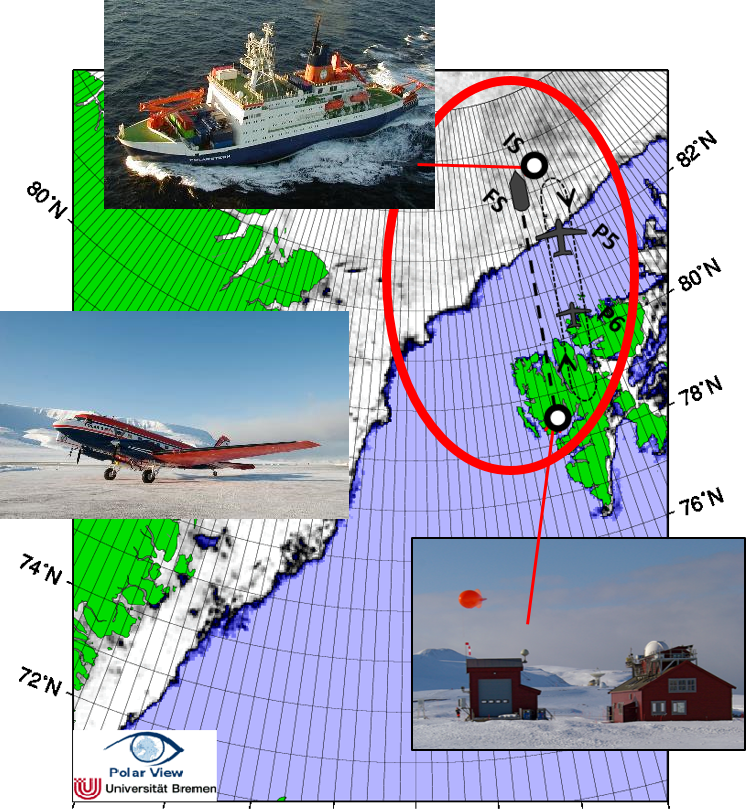
|
Objectives
| The research activities of ACLOUD combine investigations of clouds, atmospheric aerosol, trace gases, and of turbulent and radiative fluxes in cloudy and clear-sky conditions. The main aim of the cloud studies is to improve the understanding of the cloud-related processes in the Arctic atmosphere and to obtain data which can be used for testing the performance atmospheric models in the Arctic ranging from small-scale (LES) to regional and global climate models. Data will be used also for a test of parameterizations (e.g. radiation and turbulence). ACLOUD will characterize the cloud microphysical properties (cloud particle size, concentration, thermodynamic phase and shape), cloud radiative properties and aerosol properties to estimate the impact of cloud-aerosol interactions on the characteristics of the clouds. ACLOUD will focus on low level clouds within the lowest 10,000 ft of the atmosphere and especially on the atmospheric boundary layer clouds. These clouds strongly interact with the Arctic surface and potentially change the surface energy budget in sea ice and ice free areas. Therefore, ACLOUD aims to characterize cloud-surface interaction including turbulent and radiative fluxes, precipitation of snow and rain. | 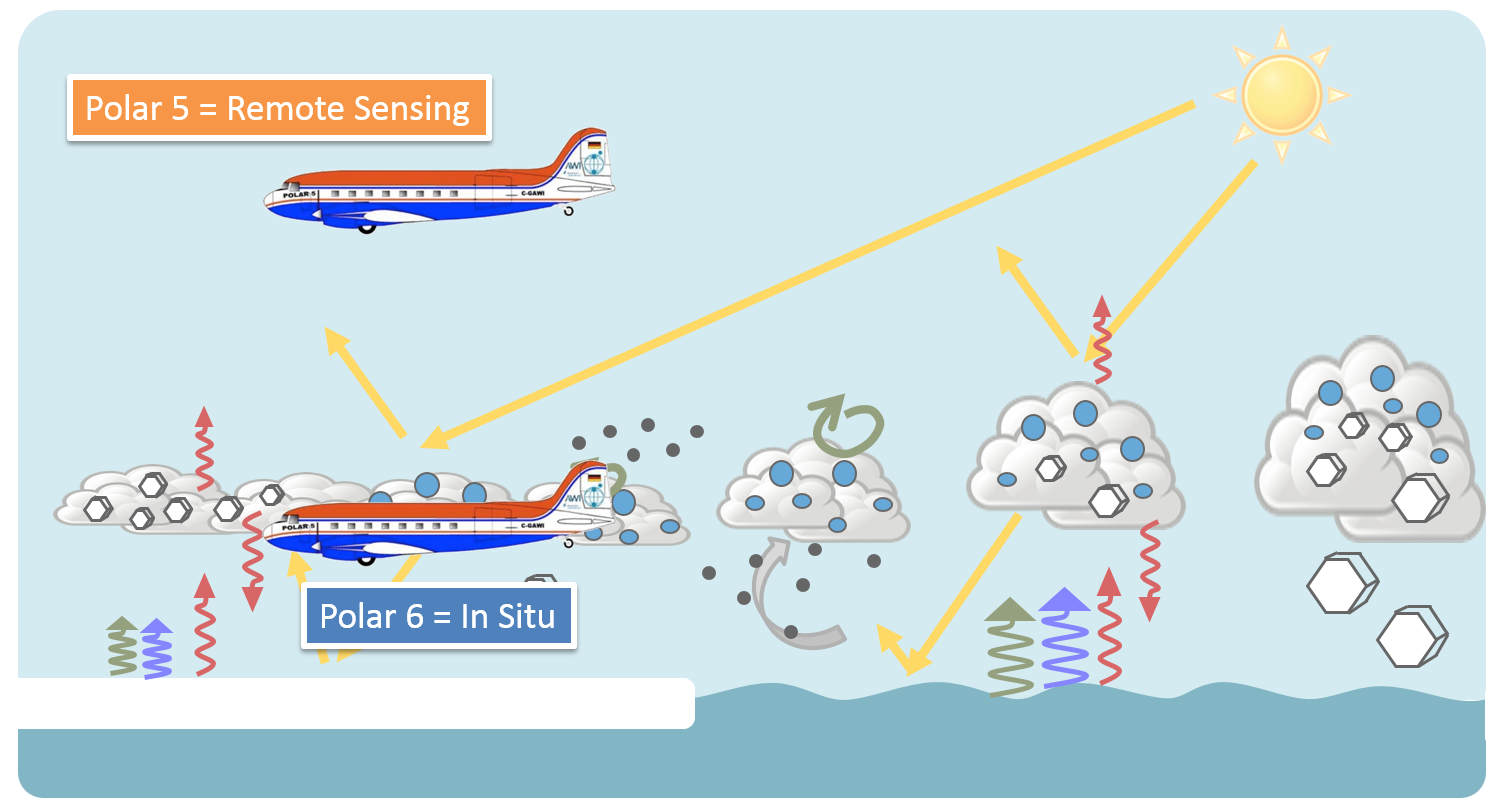
|
Location
| The operation area of Polar 5 & 6 will be adjusted to the position of Polarstern. Polarstern is expected to sail along the west coast of Svalbard north into the sea ice. The ice station is supposed to be initially at about 82.5° N and 15° E and is expected to drift towards south-west. The Polar 5 and Polar 6 aircraft will perform multiple science flights in a sector between 75-85°N and 30°W-28°E. | 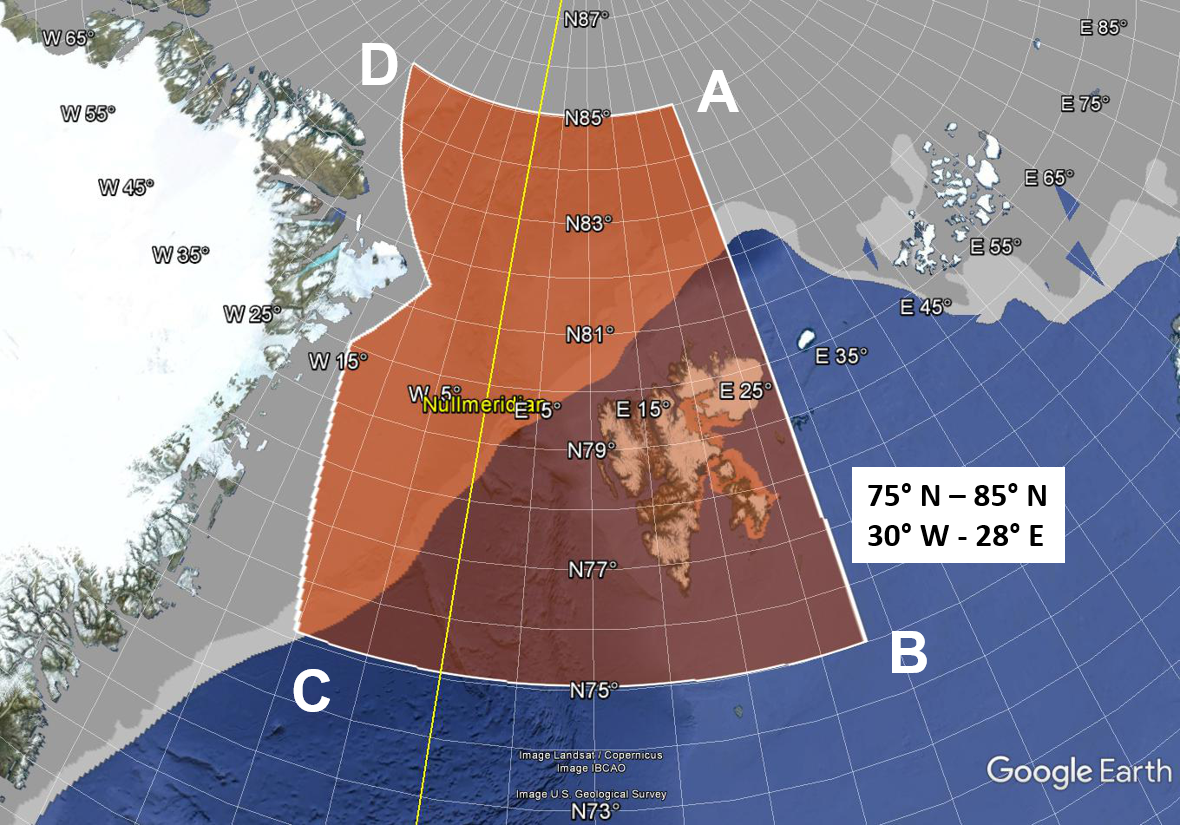
|
Instrumentation

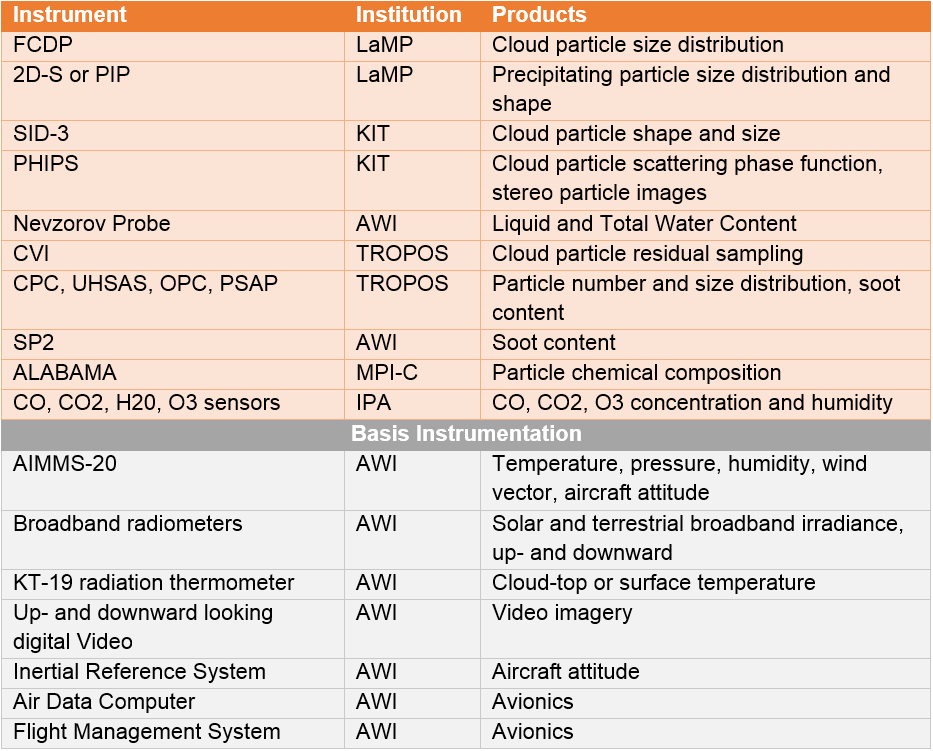
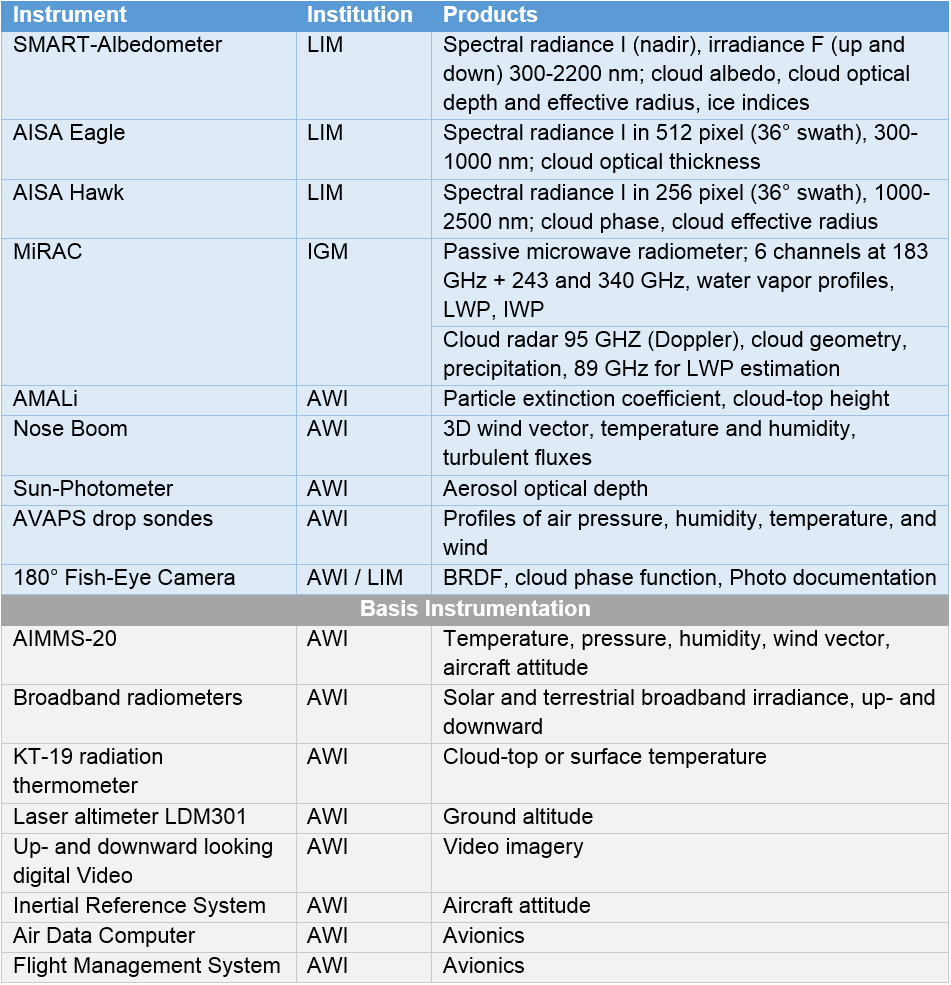
| POLAR 6 - IN SITU MEASUREMENTS | POLAR 5 - REMOTE SENSING |
|
|


 .
.