
Project Leaders: Andreas Herber, André Ehrlich



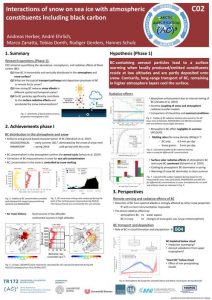
The major scientific achievements of phase I were:
- Confirmation of the annual cycle of high BC concentrations during spring (PAMARCMiP) and low BC concentrations during early summer (ACLOUD).
- BC concentration in the snow is controlled by snow melting.
- Cloud presence is the major driver of BC vertical distribution during the Arctic summer.
- The detection of BC from spectral albedo measurements is strongly affected by other snow properties and with current instrumentation impossible.
- The direct radiative forcing by atmospheric BC is minor compared to the absorption by water vapor.
- The instantaneous radiative forcing by BC in snow is minor compared to changes of snow grain size (snow metamorphism).
Based on the findings, that over Arctic sea ice the instantaneous radiative effects of BC on the surface albedo are low compared to the impact of snow grain size and that the sensitivity of remote sensing for Arctic BC concentrations is not sufficient, a continuation of this project aspect is no considered. However, in situ measurements of atmospheric BC and BC in snow remains a highly relevant task for investigation the role of BC particles for cloud formation and precipitation. This project part will be continued in B04.
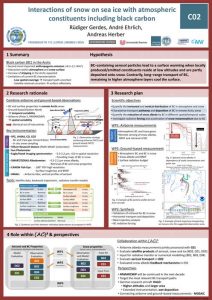
Hypothesis:
Solar energy absorbed by BC–containing aerosol particles leads to a warming of the near–surface air when locally produced/emitted constituents reside at low altitudes and are partly deposited onto the snow surface. Contrarily, long–range transport of BC into the Arctic, remaining in higher atmosphere layers, will lead to a cooling of the surface.
Achievements phase I
The radiative forcing of BC particles suspended in the atmosphere or deposited in snow over sea ice was estimated in C02 on the basis of recent measurements of Arctic BC concentrations (Kodros et al., 2018; Zanatta et al., 2018). The observations confirmed the annual cycle of high BC concentrations in spring (PAMARCMiP) and low BC concentrations in early summer (ACLOUD) (Schulz et al., 2019). Consequently, the direct radiative forcing of atmospheric BC strongly depends on the season, but, it was found to be of minor importance compared to other atmospheric constituents such as water vapour. BC concentrations in snow are observed to accumulate at the surface by melting of snow. However, the measured BC concentrations within the snow were too low to significantly contribute to a reduction of the snow albedo, which is dominated by the increase of snow grains due to snow metamorphism (factor of 10 between both effects). A detection of BC from spectral surface albedo measurements with current instrumentation was, therefore, impossible. Furthermore, the BC concentrations in cloud forming particles were measured. These investigations revealed that the presence of clouds is the major driver of BC vertical distribution during the Arctic summer. Project C02 will not be continued.
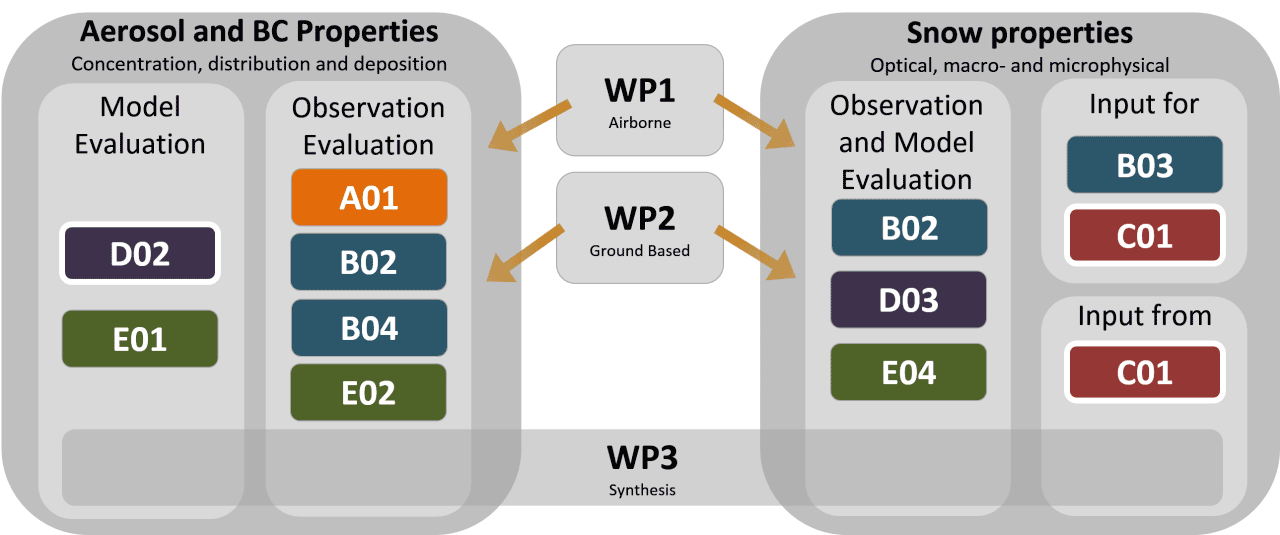
Role within (AC)³
Project Posters
| Phase II Evaluation poster 2019 | Phase I Evaluation poster 2015 | |
 |
 |
Project Members


Publications
2026
2025
2024
2023
2022
2021
Zanatta, M., Herber, A., Jurányi, Z., Eppers, O., Schneider, J., and Schwarz, J. P. , June 2021: Technical Note: Sea Salt Interference with Black Carbon Quantification in Snow Samples Using the Single Particle Soot Photometer. Atmos. Chem Phys, 21(12):9329–9342, doi:10.5194/acp-21-9329-2021
2020
Donth, T., Jäkel, E., Ehrlich, A., Heinold, B., Schacht, J., Herber, A., Zanatta, M., and Wendisch, M. , July 2020: Combining Atmospheric and Snow Radiative Transfer Models to Assess the Solar Radiative Effects of Black Carbon in the Arctic. Atmos. Chem Phys, 20(13):8139–8156, doi:10.5194/acp-20-8139-2020
Zanatta, M., Bozem, H., Köllner, F., Schneider, J., Kunkel, D., Hoor, P., De Faria, J., Petzold, A., Bundke, U., Hayden, K., Staebler, R. M., Schulz, H., and Herber, A. B. , January 2020: Airborne Survey of Trace Gases and Aerosols over the Southern Baltic Sea: From Clean Marine Boundary Layer to Shipping Corridor Effect. Tellus B Chem. Phys. Meteorol., 72(1):1695349, doi:10.1080/16000889.2019.1695349
2019
Ehrlich, A., Wendisch, M., Lüpkes, C., Buschmann, M., Bozem, H., Chechin, D., Clemen, H., Dupuy, R., Eppers, O., Hartmann, J., Herber, A., Jäkel, E., Järvinen, E., Jourdan, O., Kästner, U., Kliesch, L., Köllner, F., Mech, M., Mertes, S., Neuber, R., Ruiz-Donoso, E., Schnaiter, M., Schneider, J., Stapf, J., and Zanatta, M. , November 2019: A Comprehensive in Situ and Remote Sensing Data Set from the Arctic CLoud Observations Using Airborne Measurements during Polar Day (ACLOUD) Campaign. Earth Syst. Sci. Data, 11(4):1853–1881, doi:10.5194/essd-11-1853-2019
Jacobi, H., Obleitner, F., Da Costa, S., Ginot, P., Eleftheriadis, K., Aas, W., and Zanatta, M. , August 2019: Deposition of Ionic Species and Black Carbon to the Arctic Snowpack: Combining Snow Pit Observations with Modeling. Atmos. Chem Phys, 19(15):10361–10377, doi:10.5194/acp-19-10361-2019
Wendisch, M., Macke, A., Ehrlich, A., Lüpkes, C., Mech, M., Chechin, D., Dethloff, K., Velasco, C. B., Bozem, H., Brückner, M., Clemen, H., Crewell, S., Donth, T., Dupuy, R., Ebell, K., Egerer, U., Engelmann, R., Engler, C., Eppers, O., Gehrmann, M., Gong, X., Gottschalk, M., Gourbeyre, C., Griesche, H., Hartmann, J., Hartmann, M., Heinold, B., Herber, A., Herrmann, H., Heygster, G., Hoor, P., Jafariserajehlou, S., Jäkel, E., Järvinen, E., Jourdan, O., Kästner, U., Kecorius, S., Knudsen, E. M., Köllner, F., Kretzschmar, J., Lelli, L., Leroy, D., Maturilli, M., Mei, L., Mertes, S., Mioche, G., Neuber, R., Nicolaus, M., Nomokonova, T., Notholt, J., Palm, M., Van Pinxteren, M., Quaas, J., Richter, P., Ruiz-Donoso, E., Schäfer, M., Schmieder, K., Schnaiter, M., Schneider, J., Schwarzenböck, A., Seifert, P., Shupe, M. D., Siebert, H., Spreen, G., Stapf, J., Stratmann, F., Vogl, T., Welti, A., Wex, H., Wiedensohler, A., Zanatta, M., and Zeppenfeld, S. , May 2019: The Arctic Cloud Puzzle: Using ACLOUD/PASCAL Multiplatform Observations to Unravel the Role of Clouds and Aerosol Particles in Arctic Amplification. Bull. Am. Meteorol. Soc., 100(5):841–871, doi:10.1175/BAMS-D-18-0072.1
Schulz, H., Zanatta, M., Bozem, H., Leaitch, W. R., Herber, A. B., Burkart, J., Willis, M. D., Kunkel, D., Hoor, P. M., Abbatt, J. P. D., and Gerdes, R. , February 2019: High Arctic Aircraft Measurements Characterising Black Carbon Vertical Variability in Spring and Summer. Atmos. Chem Phys, 19(4):2361–2384, doi:10.5194/acp-19-2361-2019
Willis, M. D., Bozem, H., Kunkel, D., Lee, A. K. Y., Schulz, H., Burkart, J., Aliabadi, A. A., Herber, A. B., Leaitch, W. R., and Abbatt, J. P. D. , January 2019: Aircraft-Based Measurements of High Arctic Springtime Aerosol Show Evidence for Vertically Varying Sources, Transport and Composition. Atmos. Chem Phys, 19(1):57–76, doi:10.5194/acp-19-57-2019
2018
Knudsen, E. M., Heinold, B., Dahlke, S., Bozem, H., Crewell, S., Gorodetskaya, I. V., Heygster, G., Kunkel, D., Maturilli, M., Mech, M., Viceto, C., Rinke, A., Schmithüsen, H., Ehrlich, A., Macke, A., Lüpkes, C., and Wendisch, M. , December 2018: Meteorological Conditions during the ACLOUD/PASCAL Field Campaign near Svalbard in Early Summer 2017. Atmos. Chem Phys, 18(24):17995–18022, doi:10.5194/acp-18-17995-2018
Kodros, J. K., Hanna, S. J., Bertram, A. K., Leaitch, W. R., Schulz, H., Herber, A. B., Zanatta, M., Burkart, J., Willis, M. D., Abbatt, J. P. D., and Pierce, J. R. , August 2018: Size-Resolved Mixing State of Black Carbon in the Canadian High Arctic and Implications for Simulated Direct Radiative Effect. Atmos. Chem Phys, 18(15):11345–11361, doi:10.5194/acp-18-11345-2018
2017
Ehrlich, A., Bierwirth, E., Istomina, L., and Wendisch, M. , September 2017: Combined Retrieval of Arctic Liquid Water Cloud and Surface Snow Properties Using Airborne Spectral Solar Remote Sensing. Atmos. Meas Tech, 10(9):3215–3230, doi:10.5194/amt-10-3215-2017
Carlsen, T., Birnbaum, G., Ehrlich, A., Freitag, J., Heygster, G., Istomina, L., Kipfstuhl, S., Orsi, A., Schäfer, M., and Wendisch, M. Comparison of Different Methods to Retrieve Effective Snow Grain Size in Central Antarctica. February 2017. doi:10.5194/tc-2016-294.
Ehrlich, A., Bierwirth, E., Istomina, L., and Wendisch, M. Cloud Optical Thickness, Cloud Particle Effective Radius, and Effective Snow Grain Size Retrieved from Airborne Spectral Reflectivity Measurements during VERDI 2012 over the Beaufort Sea. 2017. doi:10.1594/PANGAEA.882979.
Carlsen, T., Birnbaum, G., Ehrlich, A., Heygster, G., Istomina, L., Schäfer, M., and Wendisch, M. Snow Specific Surface Area (SSA) Retrieved from Spectral Surface Albedo (Ground-Based and Airborne) and Reflectance (Spaceborne) Measurements at Kohnen Research Station, Antarctica, during Austral Summer 2013/14. 2017. doi:10.1594/PANGAEA.880815.


 .
.