
IRTG Travel Grants Programm – Report Eighth International Symposium on Arctic Research 2025 (Moritz Zeising)
Imagine a map of the Arctic Ocean: Most likely, you picture a map with the Fram Strait centered as the main gateway, bordered by Greenland and the Canadian Archipelago to the left, and the Nordic Seas and the Russian shelves to the right. This is also how I approached my research and defined the regions of major importance, especially since the Fram Strait represents the area where most in-situ samples are collected to be used for my model evaluation. However, the Japanese/Asian perspective can be quite different: the Bering Strait and the Chukchi Sea are the areas most frequently visited and sampled by Asian research vessels. Thus, I was curious to learn more about the perspectives of Japanese and other Asian colleagues and to foster some collaborations in that region. ISAR-8 spanned a wide range of disciplines, natural sciences, of course, but also talks, posters, and performances from social scientists, indigenous researchers, and policy advisers. Have you ever considered that you might be using indigenous words in your research brought into science by colonialism? Have you ever engaged in co-creation with local communities and developed your research questions together with local stakeholders? Have you ever incorporated non-Western knowledge systems into your analysis? As a biogeochemical numerical modeler working in the Fram Strait, I didn’t really see how to do so, until some presentations at ISAR-8 where, e.g., indigenous and local knowledge and observations were incorporated in ocean biogeochemistry models. This might remind some of you of the Arctic Science Summit Week organized by IASC, which also broadens the perspectives on the Arctic through multi- and transdisciplinary approaches. I miss these approaches in the (AC)³ community. In my opinion, there could also be much more discussion within (AC)³ on how we could increase the relevance of our research for communities and society, and on the ethical and cultural dimensions of how we conduct our work in the Arctic. The ISAR-8 organizing committee did a good job in structuring the plenary sessions, keynote talks and networking events to ensure, that the attendees were exposed to thoughts and ideas outside their usual bubble. With the support from the Tokyo-Hachioji tourism fund, the conference also offered some glimpses into Japanese culture and cuisine. However, it was sometimes really difficult to communicate with Japanese researchers because of language barriers. When words fail, origami can certainly help: try out this origami globe generator displaying your individually created ocean temperature data set: https://ads.nipr.ac.jp/handmadeEarth/origami.
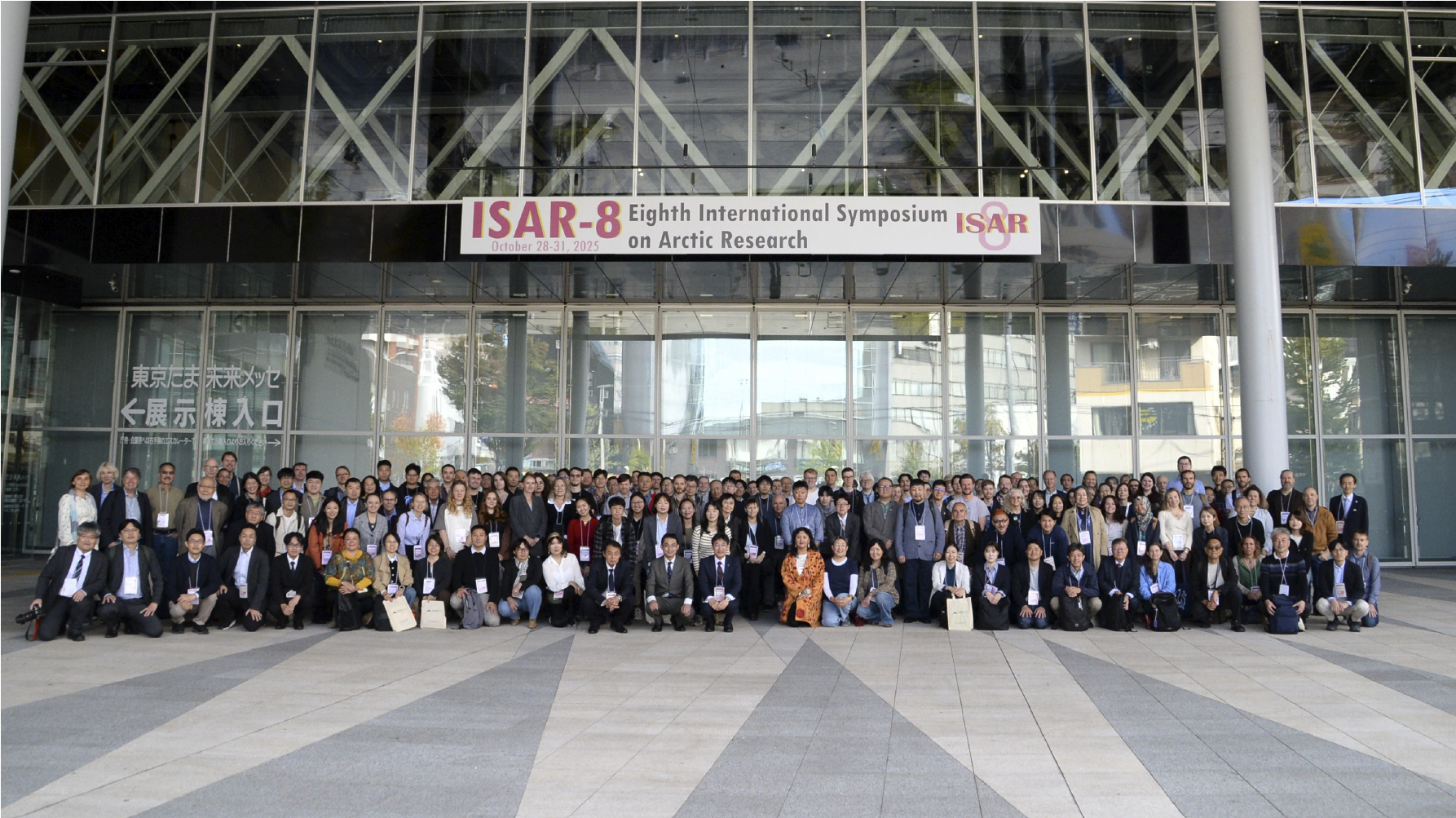
Group picture of all participants of the Eighth International Symposium on Arctic Research.
Published: 2025-11-01
By: Christa Genz


 .
.